Unlock Accounting Efficiency: Master ChatGPT Prompts for Success
Imagine this scenario: It’s peak tax season, late at night. You’re juggling numerous client files, drafting extension requests, and struggling to find the time to craft professional emails. You know the work inside and out, but you desperately need a way to accelerate your processes.
This is precisely where tools like ChatGPT can become your most valuable assistant. However, many accountants approach AI with vague requests, leading to generic, unhelpful responses. The key to unlocking its full potential lies in the quality of your prompts.

The difference between saving hours weekly with AI and finding it overhyped often boils down to one crucial element: superior prompt quality. This comprehensive guide will equip you with the knowledge and tools to master ChatGPT, transforming your daily accounting tasks.
Why Accountants Are Embracing ChatGPT Now More Than Ever
The data clearly demonstrates the transformative power of generative AI in the accounting profession. A significant 2025 study from Stanford and MIT revealed that accountants utilizing AI freed up approximately 3.5 hours each week. Moreover, they experienced a remarkable 55% increase in weekly client support compared to their non-AI-using counterparts.
Independent reports further reinforce these findings. AI accounting agents, powered by OpenAI’s advanced models, have helped firms achieve up to a 30% reduction in total working time. Additionally, Karbon’s 2025 State of AI in Accounting report highlighted that firms investing in structured AI training unlocked the equivalent of seven extra weeks of capacity per employee annually. This represents a monumental shift for a profession reliant on billable hours.
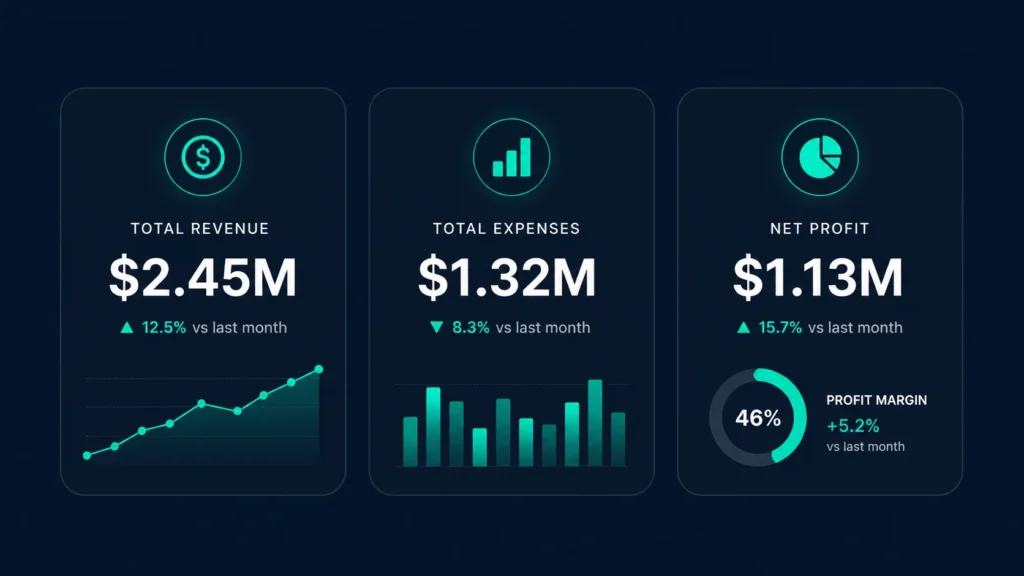
Despite these compelling benefits, AI adoption remains inconsistent across the industry. Thomson Reuters research indicates that around 52% of tax firm respondents use open-source AI tools like ChatGPT. However, only 17% have transitioned to more specialized, industry-specific AI solutions, revealing a substantial opportunity for firms willing to innovate beyond basic applications.
The Evolution of AI for Accounting in 2026
Several key advancements make 2026 a pivotal year for AI in accounting. ChatGPT’s reasoning capabilities have dramatically strengthened, with models like o3 and GPT-4.1 now adept at handling complex, multi-step financial reasoning, not just basic text generation.
The growth of Custom GPT usage also exploded, increasing 19 times in 2025. This empowers firms to train highly focused accounting assistants directly on their internal documentation and specific workflows. This customization is invaluable, especially for nuanced tasks like chatgpt prompts for tax preparation, where company-specific policies and historical data are critical.
Furthermore, new tax legislation, including provisions from the “One Big Beautiful Bill Act,” generates fresh research demands. AI serves as an excellent first-pass tool for navigating these complex updates. Simultaneously, increased regulatory scrutiny on AI usage emphasizes the critical importance of proper data hygiene and secure practices for all accounting professionals.
Crafting Powerful Prompts: The CRISP Framework
Before you dive into a library of ready-made prompts, understanding the principles behind effective prompting is essential. Most ineffective prompts share common flaws: they are vague, lack crucial context, and fail to define the desired output format.
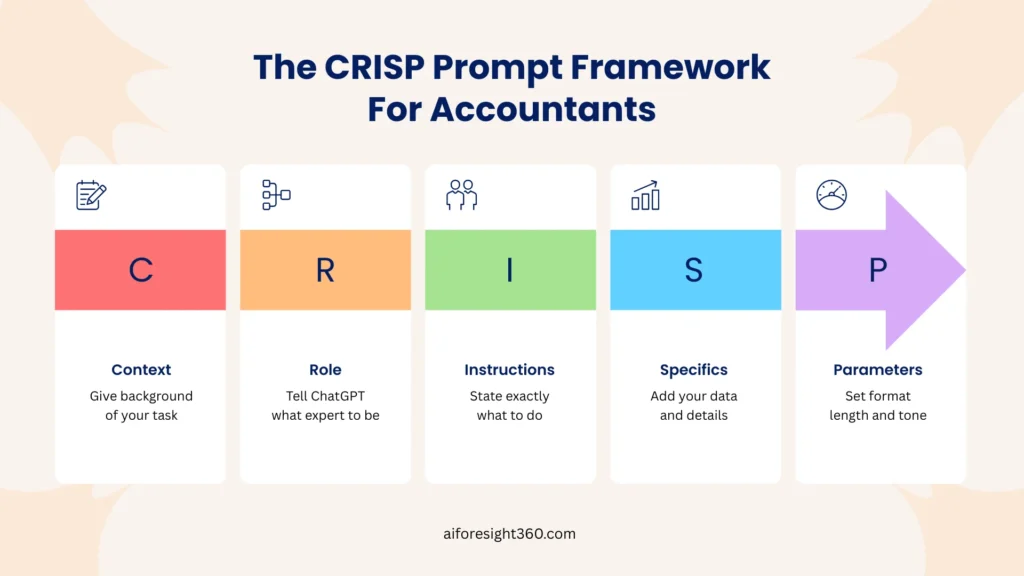
To overcome these challenges, we introduce the CRISP framework. While the full framework details will be explained as you explore specific prompts, its core idea is to guide you in providing clear instructions. This ensures ChatGPT understands your exact role, the client’s situation, and the precise output you expect.
By applying a structured approach like CRISP, you move beyond generic requests. You instruct the AI with the clarity a senior accountant would use when delegating to a knowledgeable human assistant. This refined communication unlocks truly valuable and actionable results from your AI tools.
Frequently Asked Questions About ChatGPT for Accountants
Q: How much time can ChatGPT really save accountants?
A: Studies suggest that accountants using generative AI can save approximately 3.5 hours per week. Some firms even report saving up to 30% of their total working time when integrating AI accounting agents effectively.
Q: What makes a “good” ChatGPT prompt for accounting tasks?
A: A good prompt is specific, context-rich, and role-aware. It clearly defines your request, provides necessary background information, and specifies the desired output format, much like instructing a skilled assistant.
Q: Can I use ChatGPT for complex tax preparation research?
A: Yes, ChatGPT can be an excellent first-pass tool for complex tax preparation research, especially with new legislation. However, always verify AI-generated information with official sources and professional judgment.
Q: Is data security a concern when using ChatGPT for client information?
A: Absolutely. Regulatory scrutiny on AI use is increasing. Always prioritize proper data hygiene and understand the security policies of any AI tool you use, especially when dealing with sensitive client data. Never input confidential client data directly into public AI models without proper safeguards and legal review.