Boost Your Efficiency: The Ultimate Checklist for AI Assistant for Data Entry Automation
Are you an accounting professional navigating the complexities of modern finance? While artificial intelligence (AI) is transforming various aspects of accounting, many teams still find themselves swamped with manual tasks and chasing approvals.
The real challenge isn’t just automating individual steps; it’s achieving seamless, end-to-end execution across disparate systems and teams. Let’s explore how to move beyond basic automation to truly autonomous financial operations.

Forward-thinking accounting firms are seeking solutions that don’t merely speed up tasks but intelligently complete entire workflows. This means deploying AI agents that can act, wait, and resume without losing crucial context, fundamentally changing how work gets done.
The Evolving Landscape of AI in Accounting
AI’s role in accounting has progressed dramatically, from simple document processing to advanced decision-making. However, adoption rates and capabilities still vary widely across the industry.
From OCR to Agentic Intelligence: A Quick Evolution
Initially, AI in accounting primarily focused on document-centric tasks. Optical Character Recognition (OCR) tools revolutionized accounts payable by accurately extracting invoice data, significantly reducing manual data entry.
While OCR represented a huge leap, it primarily addressed intake, not the entire follow-through process. It could read an invoice but typically couldn’t resolve a complex exception autonomously.
The next wave introduced generative and agentic AI. These sophisticated models can summarize contracts, suggest categorizations, draft variance commentary, and even help accounting professionals prepare financial reports autonomously.
Understanding the Three Tiers of AI Software Today
Today’s AI software for accounting generally falls into three distinct categories, each offering different levels of automation and intelligence:
- Automation Tools: These are task-based systems and bots designed for repetitive work, like invoice coding or expense categorization. They excel at routine, pattern-based tasks but often stop once the work deviates from a predefined pattern.
- Generative AI: These AI models specialize in creating content, such as drafting reports, summarizing account activity, or generating commentary for financial audits. They offer speed and convenience, but users typically manage the subsequent steps and approvals.
- Agentic or Predictive AI: This advanced tier involves AI that can ‘reason’ about policies, decide the next course of action, and autonomously advance a workflow. For accounting, this intelligence truly shines when integrated with an execution layer that spans across various systems like ERPs, bank portals, and communication channels.
Tangible Benefits of Integrating AI in Accounting
Despite previous limitations in end-to-end execution, finance leaders are increasingly adopting AI due to its compelling economic advantages and operational improvements.
Boosting Operational Efficiency
AI significantly reduces report cycle times, often by 60% or more. It accelerates intake, improves classification, and streamlines review processes that once consumed days during month-end close.
Many firms using AI-powered tools report a reduction of monthly close times by an average of 7.5 days. Combining AI technology with workflow automation leads to dramatically shorter cycle times for specific tasks like invoice intake and financial statement processing.
Enhancing Accuracy and Mitigating Risk
Manual accounting work is prone to human errors, fatigue, and inconsistencies, often leading to 10-15% error rates. OCR and intelligent document processing minimize keying errors, while validation logic ensures information accuracy before it moves downstream.
This combination pushes teams towards nearly 99% accuracy in data processing. The real advantage isn’t just better document reading, but a superior validation of what should happen next in the workflow.
Achieving Significant Cost Savings
Finance leaders often see a 30-40% drop in labor costs per transaction with AI implementation. Agentic workflow automation for finance means higher straight-through processing, faster close operations, and lower overall costs within the accounting function.
As AI systems take over more repetitive tasks, the labor cost per transaction consistently decreases, leading to substantial savings and improved financial performance.
Driving the Advisory Shift
Perhaps the most strategic return on investment comes from redesigning roles within the finance department. By automating repetitive tasks, employees can reallocate valuable time, often 21 hours per month, to higher-value activities like analysis, client strategy, and decision support.
This shift isn’t just about doing the same accounting faster; it’s about empowering qualified professionals with more space for critical judgment and strategic insights, transforming their contributions.
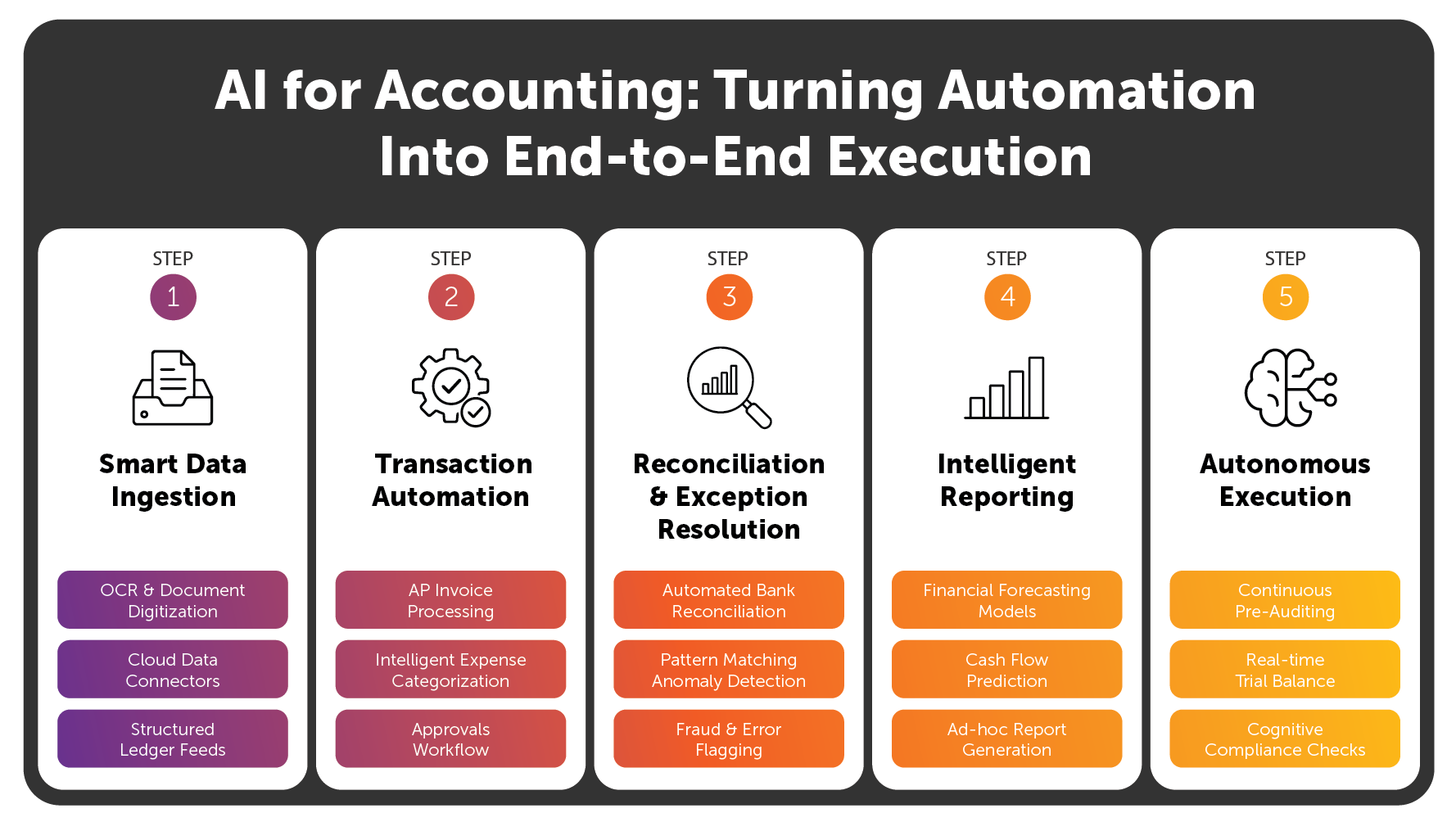
The central question isn’t whether AI will replace accountants, but rather which parts of accounting work should be automated and which should remain human-centric. AI acts as an augmentation tool, redesigning roles rather than eliminating them entirely.
The ‘Judgment Gap’ and the Augmented Controller
AI for accounting excels at compressing transcription, extraction, comparison, and summarization tasks. This allows accounting professionals to move up the value chain, focusing on policy interpretation, tax preparation, and business communication.
However, we must acknowledge the ‘judgment gap.’ Over-relying on opaque AI output can lead to issues; studies show a significant percentage of users acting on AI financial advice reported losses. In accounting, poor AI advice can lead to control failures, incorrect postings, and audit exposure.
The controller of the near future won’t be replaced by AI but will become the architect of how work gets executed under control. They will define where AI operates autonomously, where human approvals are necessary, and how evidence is retained for compliance.
Why Traditional AI Tools Often Fall Short
While traditional AI tools optimize individual steps, accounting performance hinges on seamless transitions and persistent context between those steps.
Stateful vs. Stateless AI: The Key Difference
Most chatbots are ‘stateless,’ meaning they respond to a prompt and then stop, forgetting prior interactions. Accounting work, however, is ‘stateful’ – a reconciliation might start today, pause for a bank file tomorrow, wait for internal confirmation, and then resume next week for a new discrepancy.
A stateful accounting agent remembers past actions, open items, waiting conditions, and the next steps required to complete a process. This ‘act-wait-resume’ pattern transforms a helpful assistant into an effective workflow executor.
Overcoming the Application Barrier
Accounting teams rarely operate within a single system. The ERP holds the ledger, the bank portal has cash evidence, and supporting documents live in various places. AI built into just one application cannot oversee the entire chain, leading to persistent coordination issues.
Even with AI adoption, exceptions often require manual coordination through emails and spreadsheets. While AI handles the easy 95% of transactions, the remaining 5% consumes disproportionate effort due to uncertainty, missing context, and the need for approvals.
High-Impact AI Use Cases in Accounting
AI delivers significant ROI in accounting where detection and follow-through are equally critical.
- Exception Resolution: Task-based AI reads an invoice and suggests a code. Agentic AI goes further by detecting missing purchase orders, requesting clarification, routing for approval, waiting for responses, and resuming the workflow once resolved.
- Reconciliation Follow-up and Aging Management: While traditional tools excel at matching, agentic workflows tackle unresolved items that sit for days or weeks. They can gather missing statements, compare records, escalate based on amount or age, and keep items moving until clearance or approval.
- Month-End Close Coordination: The close is a complex dependency management challenge. Agentic coordination tracks blocked tasks, notifies stakeholders of completed prerequisites, and provides visibility across fragmented accounting software environments, ensuring smoother closes.
A Checklist for AI Assistant for Data Entry Automation
When selecting AI software and tools for accounting, it’s crucial to look beyond mere convenience and consider enterprise-grade control requirements. Here’s a comprehensive checklist to guide your decision-making process:
- Security & Compliance: Does the AI tool meet enterprise-grade security standards like SOC 2 and ISO 27001? Ensure it offers role-based access, robust audit logging, and data privacy controls.
- ERP Compatibility: Can it seamlessly integrate with your existing ERP and other finance stack applications? Interoperability is non-negotiable for holistic automation across your tech landscape.
- Stateful Processing: Does the AI assistant remember context and process status across steps and over time? This is vital for complex, multi-stage accounting workflows like reconciliations that require persistence.
- Cross-System Coordination: Is it designed to work across various systems, including ERPs, bank portals, documents, email, and files? Siloed AI will inevitably fail to provide true end-to-end automation.
- Exception Handling: Can it do more than just flag issues? Look for capabilities to chase information, wait for responses, resume workflows, and escalate appropriately, seeing exceptions through to resolution.
- Native Auditability: Does the system inherently build an immutable audit trail for all AI-driven transactions? Audit readiness should be a byproduct of execution, not an additional, labor-intensive task.
- Human-in-the-Loop (HITL): Does it allow for mandatory human review and approval for sensitive actions like postings, write-offs, or payments? This preserves control and prevents ‘black box’ accounting risks.
- Explainability: Can the AI clearly explain its actions, the policies it used, and the data supporting its decisions? Transparency is crucial for trust, compliance, and effective control in finance.
- Process Automation vs. Task Assistance: Are you looking for a tool to assist a single task (task-based AI) or an agentic platform that can complete an entire workflow autonomously? Choose based on your need for end-to-end execution, not just localized help.
Built-in AI in systems like QuickBooks or Xero is excellent for localized tasks within that application. However, for processes crossing multiple systems and requiring approvals and a defensible execution history, orchestration platforms are essential.
Governance, Security, and Risk Management
Scaling accounting AI successfully requires governance to be an inherent part of execution, proactively preventing inaccuracies and maintaining data security and integrity.
Preventing ‘Black Box’ Accounting
Accountants demand transparency: they must understand what the AI did, why, which policy it followed, and the supporting information for every decision. Explainability is a foundational element of the control model in finance, not merely a ‘nice-to-have’ feature.
Building an Immutable Audit Trail
Audit readiness significantly improves when actions, approvals, and supporting evidence are captured automatically as work happens. Governed workflows that provide audit-ready execution align perfectly with finance’s critical need for a defensible process history.
Human-in-the-Loop (HITL) for Sensitive Actions
Not every accounting step should be fully autonomous. Sensitive actions, such as direct postings, significant write-offs, or payments, must still require human review and approval. Collaborative AI designs should always preserve this vital human oversight, ensuring trust and accountability.
The future of AI in accounting isn’t about replacing human expertise but augmenting it dramatically. By selecting the right AI tools and implementing them strategically, accounting firms can transcend basic automation.
Conclusion: Embracing the Autonomous Finance Function
We are moving towards an autonomous finance function where AI agents handle the complexities of data entry automation, exception resolution, and end-to-end process execution. This frees up human professionals to focus on judgment, analysis, and strategic advisory, truly transforming the accounting profession into a more valuable and engaging field.
FAQs
How does AI improve the accuracy of a month-end accounting report?
AI improves accuracy by automating data extraction, reducing manual keying errors, and applying intelligent validation logic to financial data before it’s processed. Agentic AI can also ensure all necessary inputs are gathered and reconciled, significantly minimizing discrepancies and accelerating the reporting cycle.
Can AI software work with legacy ERPs that don’t have APIs?
Yes, many advanced AI and automation platforms are designed to integrate with legacy ERPs even without direct APIs. They can use various methods, including robotic process automation (RPA), screen scraping, or database-level connections, to interact with older systems and extract or input data seamlessly.
How much does AI for accounting typically cost?
The cost of AI for accounting varies significantly based on the solution’s complexity, scope, vendor, and level of customization. It can range from subscription fees for task-based tools to substantial investments for enterprise-wide agentic platforms. Factors like implementation, training, and ongoing support also influence the total cost.
What does the future hold for AI in accounting?
The future of AI in accounting points towards increasingly autonomous and intelligent systems. Expect more sophisticated agentic AI capable of end-to-end process execution, enhanced predictive analytics, deeper integration across the financial ecosystem, and a continued shift for accountants towards strategic and advisory roles, focusing on higher-value activities.
Keywords: AI in accounting, data entry automation, AI assistant checklist, accounting automation, agentic AI, finance AI, enterprise AI tools, month-end close automation, reconciliation automation, AI for CPAs