Hey there! Did you know that AI chatbots, especially tools like ChatGPT, are rapidly transforming the accounting world? Many accounting firms now rely on them to handle compliance tasks accurately and automate routine operations. But it’s not just about simple tasks; these powerful AI tools also tackle complex challenges like detailed data analysis and crafting personalized client communications.
In this article, we’ll explore 13 fantastic ways you can use ChatGPT to supercharge your firm’s efficiency. We’ll also specifically touch upon how to use AI chatbot for audit preparation, a critical area where AI can provide immense value.
What Exactly is ChatGPT?
ChatGPT is a sophisticated large language model that you interact with through a simple chat interface. It has become one of the most popular AI tools for accounting and finance teams worldwide. Instead of rigid commands, you use casual, conversational prompts.
This AI can automate numerous manual and repetitive tasks. Think about generating text for client emails, summarizing lengthy documents, or personalizing responses to client inquiries. It also helps with research, like staying updated on regulatory changes, proofreading text for accuracy, and brainstorming fresh ideas for marketing or industry trends.
How ChatGPT Boosts Accounting Firms
Integrating ChatGPT into your operations offers several significant advantages. It frees up your team’s time and enhances the overall client experience.

1. Cuts Down Manual Work
ChatGPT can take over many tedious tasks, boosting productivity. It can help you write email replies, analyze journal entries, draft blog posts, and prepare financial reports. This gives your team more time to focus on high-value, strategic work.
For instance, ChatGPT can quickly check for discrepancies between invoiced amounts and purchase orders. Just provide the right data and context, and it excels. Imagine uploading your accounting data and simply asking, ‘Can you help automate the process of checking discrepancies between invoiced amounts and purchase orders?’
The AI will then provide a quick analysis. This task is often time-consuming and prone to human error, but the right ChatGPT prompt makes it much easier.

2. Improves Client Experience
ChatGPT significantly enhances your client interactions. It ensures professionalism and consistency across all communications by providing uniform responses. This consistency helps maintain a professional tone for your firm.
Additionally, it offers quicker responses, delivering answers in mere seconds. This speed is incredibly helpful, especially during busy seasons. ChatGPT can also draft emails for you, saving valuable time.
For example, you can use it to reply to clients, partners, and vendors efficiently. While it might not always give you the exact phrasing you prefer, it definitely provides a strong starting point to improve customer experience.
3. Supports Training and Learning
The accounting industry constantly evolves, making it challenging to keep up with new concepts, regulations, and technologies. Fortunately, ChatGPT can be a powerful ally in continuous learning.
The tool excels at providing clear explanations and examples to deepen understanding of complex concepts. You can also get hypothetical scenarios or case studies for analysis and interpretation. Furthermore, it offers insights into specialized topics like forensic accounting, tax planning strategies, or risk management techniques, making learning more accessible.
13 Practical Ways Accounting Firms Use ChatGPT
Let’s dive into the practical applications of this incredible AI tool for your accounting practice.
1. Craft Engaging Blog Posts
ChatGPT can help you create informative accounting blog posts. However, avoid relying on it completely for content generation. Instead, use it as a powerful assistant to brainstorm article ideas and create comprehensive outlines.
It’s also excellent for checking grammar, spelling, and generating SEO suggestions. Remember to use specific prompts to get the best results; otherwise, the content might turn out generic. You can try a prompt like, ‘Write in an authoritative yet informal voice, conversational and personable. Focus on business advice in accounting, addressing the reader directly. Present a problem, then guide to a resolution with actionable advice.’
When you ask ChatGPT to rewrite paragraphs or an entire blog post draft with such specific instructions, the output dramatically improves.

This distinctive writing style is more likely to resonate with your readers than generic AI-generated content.

2. Draft Client Emails Efficiently
Firm owners can leverage ChatGPT to draft personalized emails to clients. You can create a set of prompts that provide basic client information and email requirements. These prompts might include the client’s first name, industry, email purpose, and specific concerns or calls to action.
For instance, a simple prompt like, ‘Write a professional yet casual email reminder to a client about an upcoming quarterly tax return deadline. Request necessary documentation and include a friendly closing from my name,’ yields a quick draft. In seconds, you have a fresh email ready for your review and minor edits.

3. Transform Loom Videos into SOPs
Loom videos are fantastic for internal communication and reducing meetings. Now, with ChatGPT, you can take this a step further: creating Standard Operating Procedures (SOPs). This brilliant idea comes from a community member.
Simply copy and paste the transcript from your Loom video into ChatGPT. Then, ask it to summarize the transcript into a step-by-step SOP. This process streamlines documentation and ensures consistency.
4. Convert PDF Data to Excel
Manually extracting data from PDFs into Excel can be incredibly time-consuming. ChatGPT helps you streamline this process. Just copy and paste the data from your PDF documents directly into the chatbot.
Then, instruct ChatGPT to format it into a table. The resulting table is perfect for easy insertion into Excel. With the release of GPT-4, this process became even simpler, as you can now upload files directly to ChatGPT for a more convenient experience.
5. Categorize Uncategorized Bank Transactions
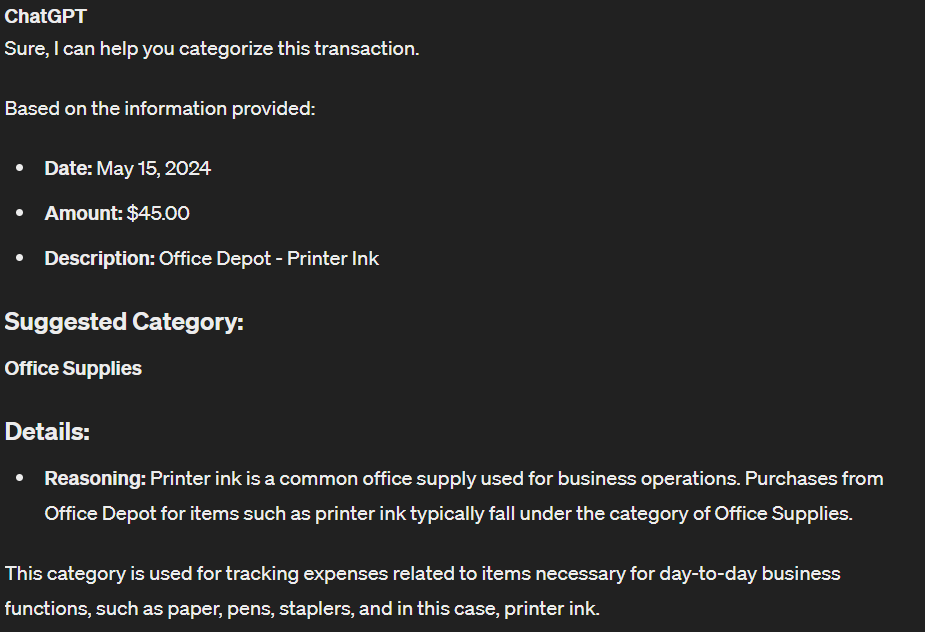
ChatGPT can dramatically speed up bookkeeping by reviewing transactions and suggesting categories. Just enter the transactions into the chatbox. The AI will then provide categorization suggestions.
You can accept or adjust these suggestions as needed, then update your records. This not only saves time but also improves accuracy. For example, if you input ‘Date: May 15 2024, Amount: $45.00, Description: Office Depot – Printer Ink,’ ChatGPT will provide an accurate categorization.
6. Create Engaging Social Media Posts
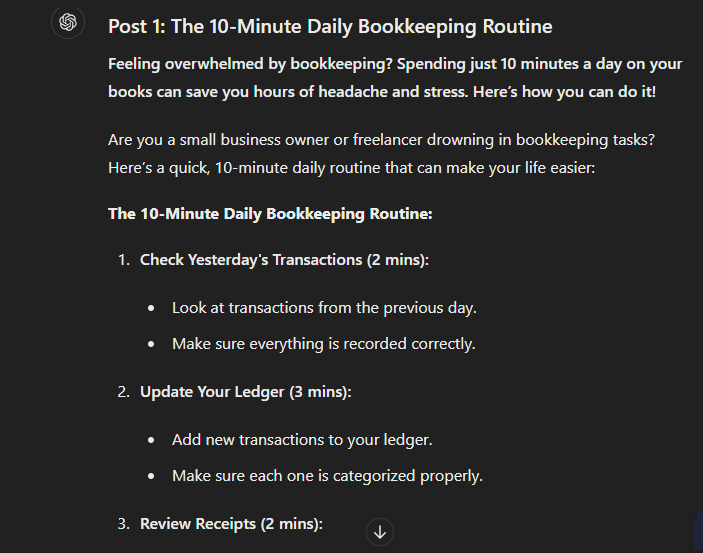
Building an online presence through social media is crucial, especially with billions of people using these platforms. However, consistently creating fresh, engaging content can be a challenge.

ChatGPT can help you generate social media posts that are relevant, engaging, and tailored to your target audience. You can always tweak your prompts, tone, and other aspects until you achieve the best results. While you’ll likely still need to edit the output, it provides a solid foundation.
7. Summarize Meeting Notes
ChatGPT excels at summarizing meeting notes, saving you precious time. Here’s a simple process you can follow: First, record your meeting using a tool like Loom that offers transcription capabilities. If your tool doesn’t transcribe, use a separate transcription service to get a text version of the meeting.
Once you have the transcription, input it into ChatGPT. You might use a prompt like, ‘Summarize the following meeting notes, focusing on key decisions, action items, and important points discussed: [Paste transcribed text here].’ This produces a concise summary, highlighting the most crucial information.

8. Resolve Excel Formula Issues
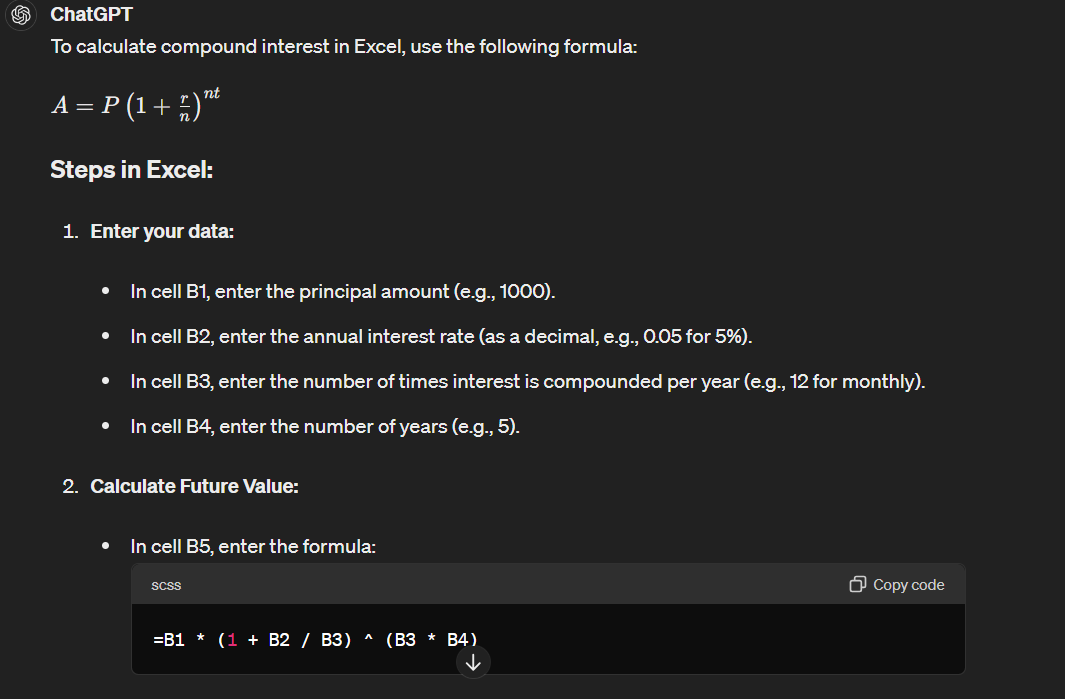
Ever forget an Excel formula or how to input it correctly? ChatGPT can provide step-by-step instructions to help you out. Simply describe the task or calculation you’re trying to perform.
ChatGPT will then provide the appropriate formula and guidance. For instance, if you ask how to calculate compound interest in Excel, it will give you the precise formula. This feature makes your financial reporting faster and easier.
For advanced needs, explore custom GPTs designed for Excel tasks, though some features might be limited for free users.

9. Drastically Reduce Market Research Time
ChatGPT can significantly cut down your market research time. It achieves this by summarizing lengthy reports and articles, answering specific questions based on the content you provide, and generating valuable insights from data. It can even recommend additional resources.
For example, you can perform competitor analysis using ChatGPT. First, collect competitor names, news articles, financial reports, and press releases. Then, provide all this data to the AI and instruct it to summarize. You can then ask targeted questions based on the provided information.

If you’re using a paid ChatGPT plan, you can leverage its advanced research model, ChatGPT 4.5, for even deeper insights.

10. Create an Email Signature for Easy Advertising
Your email signature is an often-overlooked but powerful marketing tool for your accounting firm. It offers a subtle way to advertise your services with every email you send.

If you’re unsure what to include, ChatGPT can generate a list of creative ideas for your email signature. For example, you can ask, ‘Can you send me a list of possible email CTAs for an accounting firm targeting SaaS startups?’ You’ll receive results that help you craft a compelling signature.

From these suggestions, you can choose the most compelling option for your firm.
11. Develop Better Case Studies
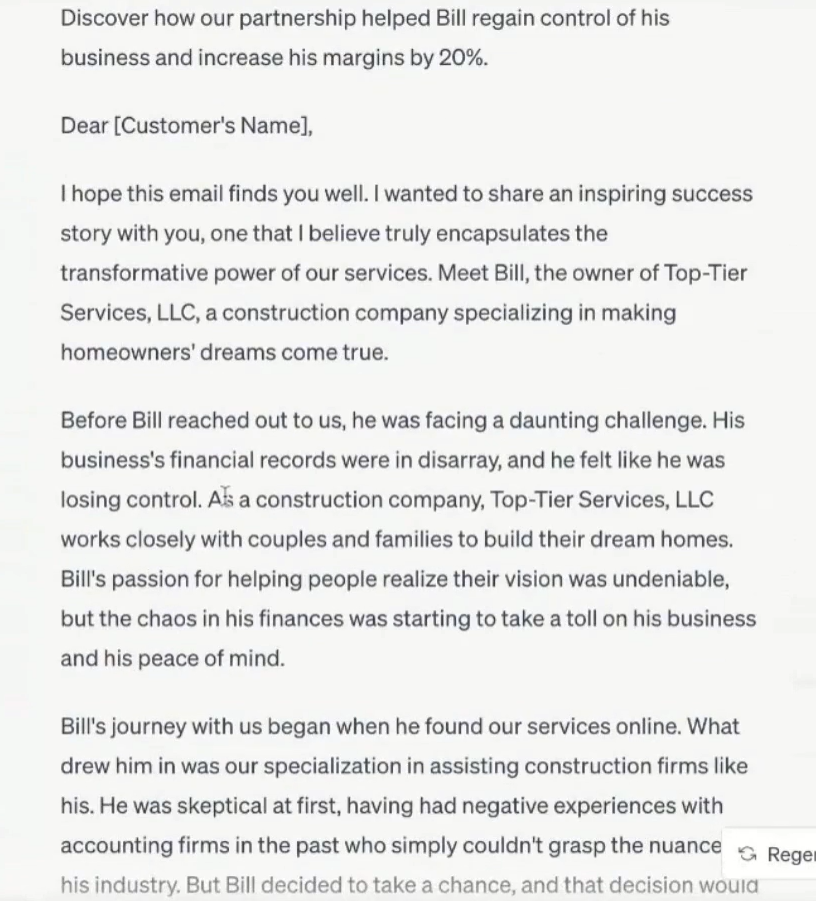
Case studies are highly effective marketing tactics because they provide intricate details of how your services benefit clients. ChatGPT can significantly assist in creating compelling client case studies.
All you need to do is include specific details in your prompt about your clients, the challenges they faced, and how your company provided solutions. The AI will then generate a draft for you. While it might need some tweaking for perfection, it offers an excellent starting point.
12. Summarize Information for Monthly Executive Summaries and Audit Preparation
Using ChatGPT to summarize information for monthly executive summaries can streamline the process, ensuring clarity and conciseness. This capability is also highly valuable for how to use AI chatbot for audit preparation, as audits often require precise, summarized financial overviews.
Always remember to anonymize sensitive information to protect privacy before proceeding. First, gather all relevant data and reports for your summary. This includes financial statements, key metrics, budget analysis, and major transactions. Next, prepare your input by clearly labeling each data section to provide context for ChatGPT.
Input your organized data and prompts into ChatGPT, specifying the required tone and length. Ensure you avoid mentioning client names or sensitive data for security. ChatGPT can then generate a comprehensive summary of financial performance and variances.
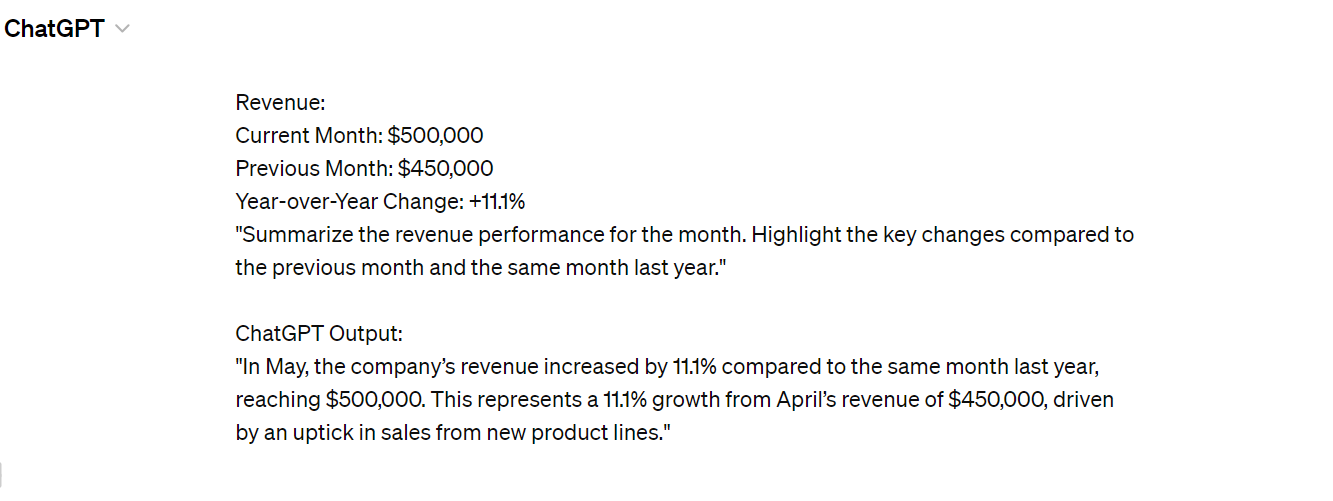
Carefully review the generated summary for accuracy and completeness. Make any necessary adjustments to ensure it aligns with your expectations and the recipients’ needs, especially when using it for audit documentation.
13. Simplify Complex Tax Regulations and Aid Audit Prep
ChatGPT can interpret complex tax regulations and provide clear, digestible summaries. This makes it much easier for accountants to understand and apply them, which is a crucial aspect of how to use AI chatbot for audit preparation.
For example, you can use a sample prompt like, ‘Can you summarize Section 179 of the new tax regulations regarding small business deductions in a more digestible manner?’ The AI will provide a simplified explanation.

Moreover, you can use it for computations. For instance, you could ask it to ‘Calculate the tax liability for a business with annual revenue of $500,000, deductible expenses of $200,000, depreciation of $30,000, tax credits of $10,000, and an applicable tax rate of 21%.’ It will provide a quick, accurate answer. This helps streamline tax-related aspects often scrutinized during audits.
Potential Risks of Using ChatGPT in Accounting
While AI offers incredible benefits, it’s essential to acknowledge the risks involved. Understanding these challenges helps you implement AI responsibly.

AI Errors
One significant risk of using ChatGPT and other AI in accounting is the potential lack of human oversight. While AI can process vast amounts of data and provide insights rapidly, it can also make mistakes. Without careful manual review, these errors might go unnoticed, leading to serious consequences.
Generic Results
ChatGPT is a machine learning tool with an impressive ability to learn. However, without sufficient human input and specific prompts, it often produces generic content. Relying solely on AI for tasks like marketing can result in bland, uninspired content that fails to capture attention. Proper oversight and refined prompts are crucial to get the best, most unique results.
Data Security Concerns
Security risks are also associated with ChatGPT and other AI models. Once financial data and other sensitive information enter an AI system, protecting that data becomes paramount. Firms must prioritize robust data security protocols and ensure compliance with privacy regulations when using AI tools.
Conclusion
ChatGPT is undeniably a game-changer for accounting firms, offering numerous ways to boost efficiency and improve client services. From drafting emails to simplifying complex tax regulations and even assisting with audit preparation, its capabilities are vast. By understanding its potential and mitigating its risks, your firm can leverage AI to thrive in the modern financial landscape.
FAQ: How to Use AI Chatbot for Audit Preparation
Q1: How can AI chatbots help with audit preparation?
AI chatbots assist with audit preparation by summarizing financial data, interpreting complex regulations, and identifying discrepancies in financial records. They can quickly process large volumes of information, allowing your team to focus on critical analysis and review.
Q2: What kind of data can I feed into an AI chatbot for audit purposes?
You can feed financial statements, transaction logs, key performance indicators (KPIs), budget vs. actual analyses, and relevant regulatory documents into an AI chatbot. Always anonymize sensitive client-specific data to maintain privacy and security.
Q3: Are there risks when using AI for audit preparation?
Yes, risks include potential AI errors, the generation of generic or incomplete information, and data security concerns if sensitive information isn’t handled properly. Human oversight and verification remain crucial to ensure accuracy and compliance.
Q4: Can an AI chatbot replace human auditors?
No, an AI chatbot cannot replace human auditors. It serves as a powerful tool to augment and streamline the audit preparation process by handling data processing, summarization, and initial analysis. Human expertise is indispensable for critical thinking, judgment, and final verification.
Q5: How do I ensure data security when using AI for sensitive financial information?
To ensure data security, use AI models that offer robust encryption and privacy features. Always anonymize or generalize sensitive client data before inputting it. Additionally, adhere to your firm’s internal security policies and relevant data protection regulations.
Keywords: AI chatbot, audit preparation, accounting firms, ChatGPT, financial automation, compliance, data analysis, client communication, tax regulations, efficiency