Mastering AI in Accounting: From Basic Automation to Autonomous Execution
Modern accounting firms face a unique challenge. Despite the widespread adoption of AI in software, many teams still struggle with manual tasks, chasing approvals, and piecing together audit support. While AI can reduce manual data entry and shorten monthly close times, a significant gap remains in achieving true end-to-end automation.
The real issue isn’t just smarter data extraction or better answers. It’s about moving toward AI agents that can act, wait, and resume tasks without losing context. This shift is crucial for transforming accounting from task-based improvements to autonomous execution.
The Evolution of AI in Accounting
AI for accounting automation is well-established, but its capabilities vary. Most finance teams utilize AI for routine tasks rather than complete processes.
From OCR to Generative and Agentic Insights
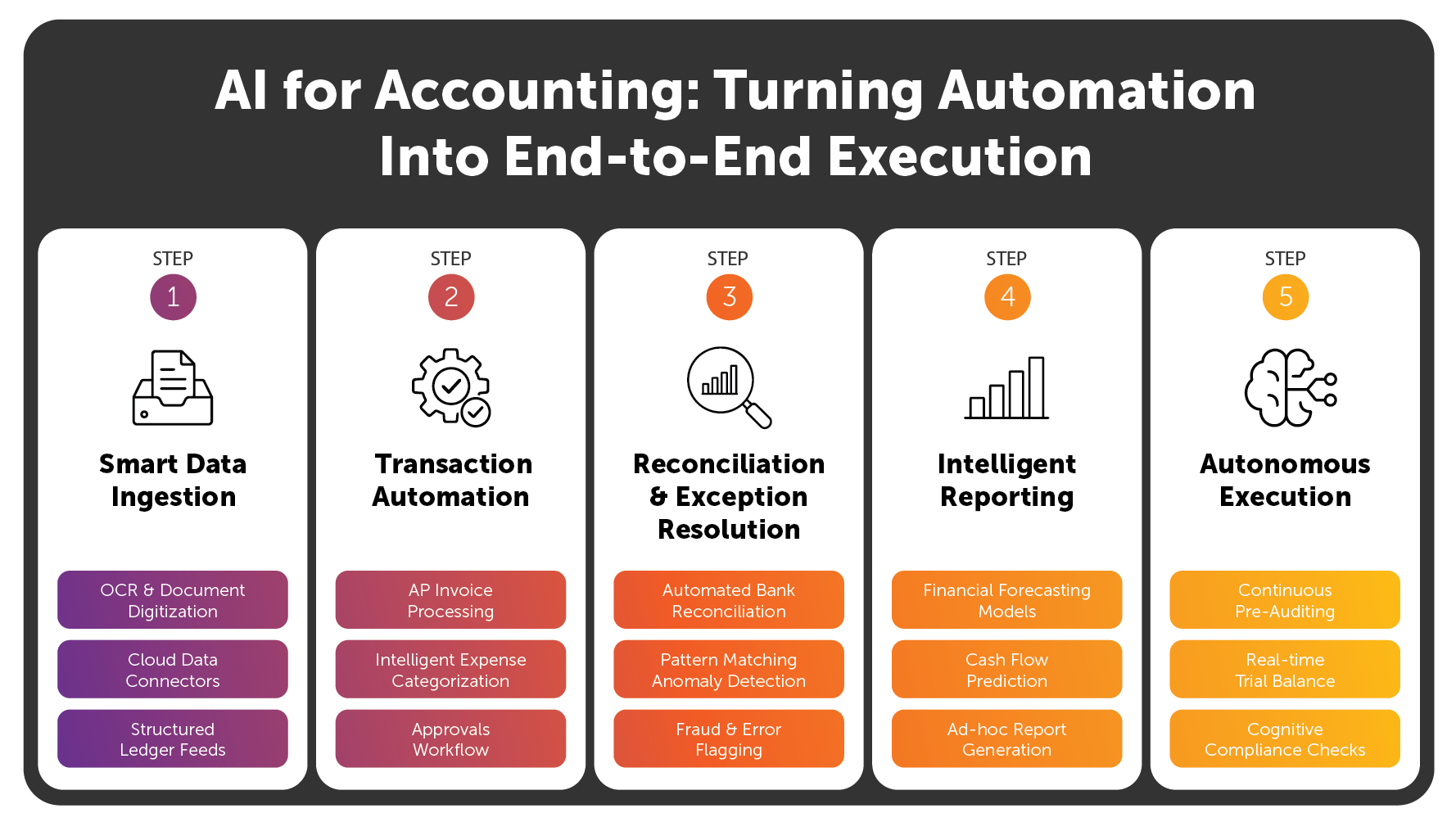
Initially, AI in accounting focused on document processing. OCR (Optical Character Recognition) tools significantly reduced manual effort in accounts payable by extracting invoice data. While a major leap, OCR primarily solved data intake, not complex follow-through or exception resolution.
The next wave introduced generative and agentic AI. These advanced models can summarize contracts, suggest categorizations, draft commentary, and even help prepare financial reports autonomously. They shift accounting teams towards higher-value work and shorten close timelines.
Three Tiers of AI Software Today
AI tools in accounting generally fall into three categories, each offering different levels of automation and intelligence.
1. Automation Tools: These are task-based systems and bots that assist with invoice coding, expense categorization, and basic data entry. They handle repetitive work efficiently but often stop when tasks deviate from predefined patterns.
2. Generative AI: Models like ChatGPT can draft accounting reports, summarize account activity, and generate variance commentary. This technology boosts speed and convenience in knowledge work, but users still need to manage subsequent steps.
3. Agentic or Predictive AI: This represents the pinnacle of accounting AI. Agentic AI can reason about policies, decide next actions, and proactively move work forward. It truly delivers value when integrated with an execution layer that spans across various accounting systems, bank portals, documents, emails, and approval workflows.
Step-by-Step Guide to ChatGPT for Data Entry Automation
For those looking to start with basic data entry automation, tools like ChatGPT offer a great entry point. While not designed for complex, end-to-end accounting processes, ChatGPT can be incredibly useful for initial data processing tasks.
First, identify repetitive data extraction or summarization tasks from unstructured text. For example, you can feed ChatGPT a series of expense descriptions and ask it to categorize them or extract specific details like vendor names and amounts. This helps to semi-automate the initial ‘reading’ and ‘transcribing’ phase of data entry.
Next, use its summarization capabilities for quick overviews of financial documents or communications, reducing the time spent manually sifting through text. While effective for these specific steps, remember that ChatGPT is generally ‘stateless’ – it responds to a prompt then stops, unlike advanced agentic AI that remembers context and continues a process.
AI Adoption Trends: Big 4 vs. Mid-Market Firms
AI adoption varies significantly across the accounting profession. While 21% of tax firms already use generative AI, a larger 53% are planning or considering it.
Larger firms, like the Big 4, invest heavily in AI for financial audit reviews and firm-wide transformations. Mid-market and smaller firms adopt AI more selectively, prioritizing immediate ROI in areas like invoice processing, reconciliations, and financial reports to boost efficiency without expanding headcount.
Measurable Benefits of AI in Accounting
Even with earlier limitations, AI implementation offers compelling economic advantages when applied correctly.
Operational Efficiency
AI dramatically reduces report cycle times, sometimes by as much as 60%. It accelerates intake, improves classification, and speeds up review work that once took days. Accounting firms using AI-powered tools have reported monthly close times falling by 7.5 days, particularly in tasks like invoice processing and financial statement preparation.
Accuracy and Risk Reduction
Manual accounting work often suffers from fatigue and inconsistency, leading to 10-15% error rates. OCR and intelligent document processing minimize keying errors, while validation logic helps check extracted information. This combination significantly improves accuracy, pushing teams closer to finance-grade reliability by validating what should happen next.
Cost Savings
Finance leaders often see a 30-40% drop in labor costs per transaction with AI implementation. Agentic workflow automation for finance leads to higher straight-through processing, faster close operations, and lower overall costs. The more repetitive work an AI system handles, the lower the labor cost per transaction becomes.
The Advisory Shift
AI frees up accountants from repetitive tasks, reallocating about 21 hours per month per employee to higher-value activities like analysis, client service, and strategic decision support. This shift allows qualified professionals more room for expert judgment, enhancing the quality of forecasting and organizational decision-making.
Will AI Replace Accountants?
The better question isn’t whether AI will replace accountants, but rather which parts of accounting work should be automated and which should remain human. AI is not about replacing roles, but redesigning them.
From Transcription to Judgment: AI Tools Augment the CPA
AI excels at compressing transcription, extraction, comparison, and summarization tasks. This allows accounting professionals to move up the value chain, focusing on policy interpretation, tax preparation, and business communication. The role evolves to become more analytical and supervisory.
The ‘Judgment Gap’: Why Poor AI Advice is Risky
Over-relying on AI carries risks. Surveys show that roughly one in five users who acted on AI financial guidance reported losing money. In accounting, bad advice can lead to control failures, incorrect postings, or audit exposure. Finance teams must exercise caution and not treat opaque AI output as inherently safe.
The Role of the AI-Augmented Controller
Controllers won’t be replaced by AI; instead, they will become architects of controlled execution. They will decide where AI can operate autonomously, where manual approvals are necessary, how evidence is retained, and how exceptions escalate. Humans will retain judgment, while AI expands the organization’s capacity for consistent execution.
Why Traditional AI-Powered Tools Fall Short
Traditional AI often optimizes individual steps, but accounting performance relies on seamless transitions between steps. This is where many current AI tools hit a wall.
Stateful vs. Stateless AI: Why Your Chatbot Can’t Finish a Reconciliation
Most chatbots, like basic generative AI, are stateless. They respond to a prompt and then stop, forgetting prior context. Accounting work, however, is stateful. A reconciliation might start today, pause for a bank file tomorrow, wait for internal confirmation, and then reopen next week if a discrepancy appears. This isn’t a single interaction; it’s a dynamic process.
A stateful accounting agent remembers past actions, open items, conditions it’s waiting for, and the next action to take when those conditions are met. This ‘act-wait-resume’ pattern distinguishes a helpful assistant from a true process-executing worker.
The Application Barrier: Siloed AI Fails to Bridge Systems
Accounting teams rarely operate within a single system. Ledgers reside in ERPs, cash evidence is in bank portals, purchase orders might be in procurement systems, and clarifications in email. AI built into just one application cannot oversee or govern the entire chain, explaining why coordination issues persist even after AI adoption.
Why Exceptions Still Require Manual Coordination
AI can handle the easy 95% of tasks, but the remaining 5% often consumes disproportionate effort. These exceptions involve uncertainty, missing context, approvals, and follow-up that spill into inboxes and spreadsheets. Traditional AI flags issues and stops, leaving someone to manually chase resolution.
Where in Accounting Does AI Deliver ROI? (High-Impact Use Cases)
AI delivers the strongest ROI in accounting where follow-through is as vital as detection.
-
Exception Resolution: Task-based AI reads an invoice and suggests a code. Agentic AI goes further. It detects a missing purchase order, requests clarification from the vendor, routes the invoice for approval, waits for a response, and then resumes the workflow once the exception is resolved.
-
Reconciliation Follow-up and Aging Management: While traditional tools excel at matching, agentic workflows tackle unresolved items that linger. They gather missing statements, compare records, escalate based on amount or age, and keep items moving until a variance is cleared or approved for further action.
-
Month-End Close Coordination: The close process is a dependency management challenge. Agentic coordination tracks blocked tasks, notifies stakeholders when prerequisites are met, and maintains visibility across fragmented accounting software environments, ensuring smoother, faster closes.
Selecting the Right AI Software and AI Tools for Accounting
Not all AI in accounting is designed for enterprise execution. Selection criteria must prioritize finance’s control requirements over mere user convenience.
Criteria for Enterprise-Grade AI Tools
Enterprise-grade finance AI must meet stringent standards for security, control, and interoperability. Look for certifications like SOC 2 and ISO 27001, along with role-based access, audit logging, and compatibility with your ERP and other finance systems.
Built-in AI vs. Orchestration Platforms
Built-in AI (e.g., in QuickBooks or Xero) is useful for problems confined within a single application. It assists with categorization, summaries, and local productivity. Orchestration platforms become essential when processes span multiple systems, requiring waiting, approvals, and a defensible execution history.
Task-Based AI Tools vs. Agentic Process Automation Platforms
| Capability | Task-based AI tools | Agentic process automation platforms |
|---|---|---|
| Primary value | Assist a task | Complete a workflow |
| Memory of prior state | Minimal | Persistent across steps and time |
| Cross-system coordination | Limited | Designed for ERP, portals, docs, email, files |
| Exception handling | Flags issues | Chases, waits, resumes, escalates |
| Auditability | Often partial | Embedded execution history |
| Human approvals | Separate or manual | Built directly into the workflow |
Governance, Security, and Risk Management
Accounting AI scales effectively only when governance is an intrinsic part of its execution, preventing ‘hallucinations’ and ensuring data security.
Preventing ‘Black Box’ Accounting: Ensuring Explainability
‘Black box’ accounting is unacceptable. Accountants must understand what the AI did, why it did it, which policy it followed, and what information supported its decisions. Explainability is a crucial component of the finance control model, not just a nice-to-have feature.
Building an Immutable Audit Trail for AI-Driven Transactions
Audit readiness significantly improves when actions, approvals, and supporting evidence are captured as work happens. Audit logs and audit-ready execution within governed workflows directly align with finance’s need for a defensible process history.
Human-in-the-Loop (HITL): Why Sensitive Actions Need Manual Approval
Not every accounting step should be fully autonomous. Sensitive actions such as postings, write-offs, or payments must still require human review and approval. Collaborative AI and human-in-the-loop design preserve essential oversight and control.
Conclusion: Moving Toward the Autonomous Finance Function
The future of AI in accounting lies in moving beyond simple task automation to autonomous, stateful execution. By embracing agentic AI, firms can transform their operations, reduce manual effort, enhance accuracy, and empower their professionals to focus on strategic judgment rather than transactional processes. This strategic shift will redefine the finance function, making audit readiness a byproduct of efficient, controlled execution.
Keywords: AI in accounting, accounting automation, generative AI, agentic AI, data entry automation, ChatGPT for finance, financial technology, month-end close automation, ERP integration, audit trails