Advanced Tips for Harnessing Claude AI in Your Monthly Close Process
In today’s fast-paced business world, technologies like artificial intelligence (AI) are rapidly transforming how we operate. While some might fear AI replacing human roles, it’s actually a powerful ally when used wisely. Embracing AI tools, such as Claude AI, opens up new avenues for enhancing efficiency and accuracy in critical financial operations, particularly during the monthly close.

Instead of acting as a replacement, smart AI systems like Claude serve as advanced assistants. They help finance professionals streamline workflows, tackle complex challenges, and re-focus their expertise on higher-value strategic tasks. This integration boosts productivity and unlocks the true potential of human intelligence and creativity within your finance team.
This article dives into how Claude AI can revolutionize your monthly close process, offering advanced tips to enhance your work and usher in a new era of financial management.
Curious about AI’s impact on business? Experts often discuss how AI influences various operations, from manufacturing to finance, highlighting its potential for improvement. 
What Exactly is Claude AI?
Claude AI is a sophisticated AI program designed for natural, conversational interactions. Think of it as a highly intelligent chatbot capable of understanding and generating human-like text across a vast range of topics. Developed by Anthropic, Claude has been trained on extensive datasets, equipping it with broad knowledge.
When you interact with Claude AI, whether by asking questions or providing information, it employs advanced techniques to comprehend your intent. It then uses its powerful computational abilities to generate clear, relevant, and contextually appropriate responses, making conversations feel remarkably authentic.
Claude’s capacity to mimic human language is truly impressive. With the right prompt, it can even adapt its response style. However, it’s vital to remember that Claude AI, despite its advanced capabilities, operates purely on computational algorithms and acquired knowledge; it doesn’t possess human consciousness or emotions. Nevertheless, its proficiency in understanding and generating text unlocks exciting possibilities across numerous domains, including the intricate world of finance.
Advanced Tips for Claude AI in Your Monthly Close Process
Claude AI offers immense potential to transform the accounting field, especially the monthly close. Its advanced language processing capabilities can streamline and automate various tasks, saving time and significantly boosting efficiency. By effectively using Claude AI, finance teams can enhance productivity, gain deeper insights, and make more informed decisions.

1. Automate Preliminary Data Reconciliation
To streamline your monthly close, leverage Claude AI to automate preliminary data reconciliation. This includes categorizing high volumes of transactions, matching entries across different ledgers, and drafting initial journal entries based on established rules. This significantly reduces manual effort and accelerates the initial stages of the close.
2. Draft Financial Reports and Narratives
Utilize Claude AI to generate initial drafts of key financial statements like balance sheets, income statements, and cash flow reports. Beyond raw data, Claude can also draft accompanying narratives and explanations for performance trends, helping you quickly prepare comprehensive reports for stakeholders.
3. Perform Advanced Variance Analysis
Employ Claude AI to conduct sophisticated variance analysis. Provide it with actuals versus budget/forecast data, and ask it to identify significant discrepancies, explain potential causes, and even flag unusual transactions or accounts that require deeper investigation. This provides quick, actionable insights crucial for month-end reviews.
4. Ensure Policy Compliance Checks
Integrate Claude AI into your compliance workflow by having it cross-reference month-end entries and reports against accounting standards (e.g., GAAP, IFRS) and internal policies. This helps automate compliance checks, reduce the risk of errors, and ensure financial statements adhere to all necessary regulations.
5. Streamline Complex Journal Entries
For recurring or complex journal entries, Claude AI can assist in their generation. By inputting source data and general rules, Claude can draft entries for accruals, deferrals, depreciation, and intercompany transactions, improving accuracy and consistency.
6. Enhance Cash Flow Management and Forecasting
While primarily a closing tool, Claude AI can also project future cash flows based on historical data and current performance during the close. Use it to perform ‘what-if’ scenario analysis, helping you anticipate potential cash shortages or surpluses for the upcoming period and informing strategic planning.
7. Develop Custom Prompts for Specific Tasks
Mastering prompt engineering is key to advanced use. Develop specific, detailed prompts for Claude AI to perform highly specialized tasks, such as summarizing anomalies found in a general ledger, identifying potential fraud indicators from transaction data, or outlining steps for a specific account reconciliation challenge. The more precise your prompts, the more tailored and useful Claude’s outputs will be.
Benefits of Using Claude AI for Monthly Close
Integrating Claude AI into your monthly close process offers a range of benefits that significantly improve financial management. Here are some key advantages:

1. Boosted Efficiency and Time Savings
Claude AI automates repetitive month-end accounting tasks, like data entry, categorization, and initial report generation. This allows your team to focus on strategic analysis and problem-solving, dramatically improving overall efficiency and saving valuable time during a typically intense period.
2. Enhanced Accuracy
Leveraging Claude’s computational power helps minimize human errors in calculations, data entry, and financial analysis, particularly during complex month-end adjustments. Its ability to process large volumes of data with precision significantly enhances accuracy and reduces the risk of costly mistakes.
3. Advanced Data Analysis and Insights
Claude AI can swiftly analyze vast amounts of financial data from the close, identifying patterns, trends, and anomalies much faster than manual methods. This enables accountants to gain valuable insights, pinpoint areas for improvement, and make data-driven decisions more effectively.
4. Rapid Access to Relevant Information
Claude provides prompt responses to financial queries, offering real-time information and summaries. Accountants can access critical data, understand report nuances, and gain insights on demand, enabling faster resolutions during the close.
5. Superior Decision-Making Support
With its ability to generate meaningful insights, forecasts, and scenario analyses, Claude AI directly supports informed business decisions. It helps finance professionals predict outcomes, analyze financial risks, and devise effective strategies for the period ahead.
6. Robust Audit and Compliance Assistance
Claude AI assists audit processes by detecting potential errors or irregularities in financial statements derived from the close. It automates compliance checks against regulatory standards, ensuring adherence and improving the efficiency and effectiveness of audit preparations.
7. Continuous Learning and Adaptability
Claude AI can be trained with specific organizational data and customized to adapt to your unique accounting practices and evolving regulations. It can learn from previous interactions and feedback, continually improving its responses and becoming more aligned with your specific monthly close requirements over time.
Challenges of Using Claude AI for Monthly Close
While using Claude AI for your monthly close offers numerous benefits, it’s also important to acknowledge potential challenges. Being aware of these helps you implement the technology responsibly.

1. Trustworthiness and Reliability
Claude AI generates responses based on patterns from its training data. However, it may occasionally produce inaccurate or unreliable results, especially with highly complex or ambiguous financial queries. Careful human verification and oversight are absolutely essential to ensure the accuracy of generated financial information. Blindly trusting AI-generated outputs for critical financial documents can have significant repercussions.
2. Contextual Understanding Limitations
Claude AI might struggle to fully grasp the nuanced context or specific intent behind a complex accounting question, potentially leading to incomplete or incorrect responses. It may interpret queries too literally or miss subtle industry-specific jargon, which could impact the reliability of its financial analysis.
3. Data Privacy and Security Concerns
Utilizing Claude AI for monthly close processes often involves sharing sensitive financial data. Implementing robust privacy protocols and strict security measures becomes paramount to protect this confidential information from unauthorized access or data breaches.
4. Ongoing Training and Maintenance
To remain relevant and effective, Claude AI requires continuous training and updates, especially as accounting practices, regulations, and industry standards evolve. Maintaining an up-to-date dataset and implementing regular updates can be resource-intensive.
5. Ethical Considerations
Since Claude AI generates responses based on its training data, there’s a risk of perpetuating biases present in that data. It’s crucial to proactively address and mitigate these biases to ensure fair, impartial, and compliant outcomes in your accounting processes.
6. Limited Understanding of Highly Complex Scenarios
Claude AI may struggle with highly specialized or unique accounting scenarios that demand deep domain expertise, intricate professional judgment, or real-time interpretation of ambiguous regulations. Its responses might lack the human intuition necessary for truly complex financial analysis.
7. Infrastructure and Network Dependency
As an online service, Claude AI requires a stable internet connection and reliable infrastructure. Any disruptions in connectivity or technical issues could hinder its availability, impacting the efficiency of your monthly close workflow.
To navigate these challenges successfully, it’s vital to strike a balance between leveraging Claude AI’s powerful capabilities and maintaining essential human expertise and oversight. Combining AI’s strengths with the critical thinking and judgment of human finance professionals will maximize benefits and mitigate risks.
How Claude AI Will Impact the Accounting Industry
Claude AI is set to significantly impact the accounting industry, introducing transformative changes that will reshape traditional practices, especially around core processes like the monthly close. Here are some key ways Claude AI is expected to influence the accounting landscape:

1. Automation of Routine Tasks
Claude AI will increasingly automate routine and repetitive accounting tasks, such as data entry, transaction categorization, and initial report generation. This reduces manual effort, significantly enhances productivity, and allows accountants to dedicate more time to strategic analysis and interpretation.
2. Enhanced Accuracy and Error Reduction
Claude AI’s capabilities minimize human errors in data processing, calculations, and analysis. Its ability to precisely handle vast amounts of data improves the accuracy of financial reporting and analysis, leading to more reliable and correct financial information, particularly critical during the close.
3. Advanced Data Analysis and Insights
By analyzing extensive financial data, Claude AI provides accountants with deeper insights than ever before, supporting truly data-driven decisions. It helps identify patterns, trends, and anomalies more quickly, empowering finance professionals to stay informed and optimize financial performance.
4. Stronger Compliance and Audit Support
Claude AI helps ensure compliance with accounting regulations and standards by automating compliance checks and supporting audit processes. This enhances the effectiveness and efficiency of regulatory adherence and auditing, reducing the risk of errors and potential legal issues.
5. Evolution of Accountant Roles
As AI handles more transactional tasks, the role of accountants will evolve. They will shift towards more analytical, advisory, and strategic functions, focusing on interpreting AI-generated insights, managing AI systems, and providing expert judgment on complex financial matters.
Integrating AI with Your Financial Systems
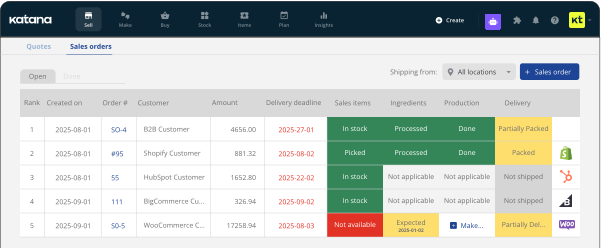
While Claude AI offers a powerful general AI assistant for many tasks, businesses can also benefit from specialized AI tools that integrate directly with existing ERP and financial management systems. These tailored solutions can automate data entry, generate real-time business overviews, and provide instant graphical representations of financial data, designed specifically for intricate business needs.

Such integrations eliminate the need for manual data entry and scattered information, allowing finance teams to focus on strategic insights rather than administrative burdens. By leveraging AI directly within your financial ecosystem, you can streamline operations, automate routine processes, and foster growth more effectively.
Frequently Asked Questions (FAQ)
Q1: Can Claude AI completely replace human accountants during the monthly close?
No, Claude AI cannot completely replace human accountants. While it excels at automating repetitive tasks and providing valuable insights, human oversight, critical judgment, and ethical considerations remain essential for accuracy, compliance, and interpreting complex financial scenarios during the monthly close.
Q2: What kind of financial data can I safely share with Claude AI for monthly close tasks?
When using Claude AI for sensitive monthly close tasks, prioritize data privacy and security. While it can process various financial data, always anonymize sensitive personal information where possible and ensure you comply with all data protection regulations. Never share highly confidential or proprietary data without robust security measures in place.
Q3: How can I ensure the accuracy of Claude AI’s outputs for financial reporting?
To ensure accuracy, always treat Claude AI’s outputs as a first draft or a powerful assistant. Implement a stringent human review process, where qualified accountants verify all AI-generated reports, reconciliations, and journal entries. Cross-reference its findings with primary source documents and apply professional judgment before finalizing any financial statements.
Q4: What’s the most advanced tip for leveraging Claude AI in the monthly close?
The most advanced tip is mastering prompt engineering to create highly specific, multi-step prompts. This allows Claude AI to perform complex tasks like identifying subtle anomalies in a general ledger, performing multi-variable variance analysis, or even drafting detailed explanations for auditor inquiries based on specific financial data and rules.
Q5: Is Claude AI suitable for small businesses or primarily for large enterprises in the context of monthly close?
Claude AI is scalable and can benefit both small businesses and large enterprises. Small businesses can leverage it for basic automation and insights, while larger organizations can integrate it into complex ERP systems for advanced data analysis and large-scale process optimization during their monthly close.
Keywords: Claude AI, monthly close process, accounting automation, financial management, AI in finance, financial close, AI tips, accounting technology, data reconciliation, financial reporting