Artificial intelligence (AI) is rapidly transforming the accounting industry, moving it beyond traditional manual processes into an era of unprecedented efficiency. Experts project the global AI accounting market to reach an astonishing $10.87 billion by 2026, driven significantly by small and medium-sized enterprises (SMEs).
This widespread adoption isn’t just hype; Gartner’s 2024 survey indicates AI saves organizations an average of 5.4 hours per week. As firms mature their AI implementation, these time savings translate into tangible value, particularly for tax and accounting professionals.
The accounting profession is undergoing a fundamental shift, with data entry and core bookkeeping tasks increasingly automated. This allows professionals to focus on strategic insights and analytical challenges. This article will provide a step-by-step guide to generative AI for data entry automation and explore the broader impact of AI in accounting.

The Evolution of AI in Accounting: From Basic Automation to Intelligent Agents
While AI in accounting might seem like a recent phenomenon, its impact began to take shape around 2015 with rules-based automation. Early applications focused on processing structured data, categorizing transactions, and matching entries based on predefined rules.
A significant leap occurred in 2023 with the advent of generative AI. Large Language Models (LLMs) moved beyond simple pattern recognition, enabling sophisticated content generation and complex reasoning. McKinsey highlights this shift as a ‘quantum leap,’ allowing automation of higher-order accounting functions previously impossible.
Today, AI empowers finance teams to draft reports, summarize regulatory changes, enforce compliance, and track cash flow patterns with minimal human intervention. Looking ahead, agentic AI promises to revolutionize workflows further by autonomously planning and executing complete accounting processes, from journal entries to management reports.

Where AI Makes an Impact: Key Use Cases in Finance Today
AI’s influence extends across various financial sectors, from bankruptcy and stock-price forecasting to anti-money laundering (AML) compliance and behavioral finance analysis. Investment firms leverage predictive models, banks utilize AI for fraud detection, and energy companies rely on intelligent forecasting for commodity markets.
However, for most organizations, AI delivers its most significant impact on everyday accounting tasks. These foundational areas include financial reporting, accounts payable and receivable (AP/AR) management, tax compliance, audit workflows, and general ledger reconciliation.
These applications are particularly well-suited for AI because they involve high volumes of data and adhere to clear rules and structures, making the benefits measurable and the implementation path straightforward.
Embedded vs. AI-Native: Choosing the Right Accounting Platform
Major enterprise resource planning (ERP) vendors like SAP and Oracle have begun integrating AI capabilities directly into their existing systems. While this offers some automation, these features are often bolted onto older architectures not originally designed for modern AI development.
This approach, though showing AI’s growing importance, limits the depth of integration and requires vendors to maintain backward compatibility. Consequently, these retrofitted systems may not deliver the full potential of AI-powered automation and intelligent insights.
In contrast, AI-native accounting platforms are built from the ground up with AI at their core. Solutions offer more intuitive automation and deeper intelligence because their architecture is optimized for AI. Businesses considering long-term platform decisions should carefully evaluate the distinction between embedded and truly native AI architectures.
Understanding AI Adoption: Who’s Using It and How
AI adoption in financial services is accelerating rapidly. A Bank of England report from 2024 revealed that approximately 75% of UK financial firms already use AI, with another 10% planning implementation within three years.
However, the depth and effectiveness of AI integration vary significantly across organizations. KPMG’s Global AI in Finance Report categorizes adoption into three tiers:
- Leaders (24%): These companies have embedded AI across multiple processes, achieving substantial efficiency gains and competitive advantages.
- Implementers (58%): These firms have deployed AI in specific functions but have yet to achieve full, enterprise-wide integration.
- Beginners (18%): These organizations are still in the pilot or early-stage deployment phases of their AI journey.
Moving up these maturity tiers directly correlates with improved performance and productivity. Organizations transitioning from early experimentation to mature AI strategies report significant functional enhancements.
SMEs Lead the Charge: AI Becomes Accessible to All
Small and medium-sized enterprises (SMEs) are now driving the next wave of AI investment in accounting. Mordor Intelligence projects SME adoption to propel the AI accounting market at a 44.6% Compound Annual Growth Rate (CAGR), reaching $10.87 billion by 2026.
This shift stems from increased accessibility through cloud infrastructure, open Application Programming Interfaces (APIs), and flexible subscription models. Previously, AI implementation demanded significant capital and technical resources, largely limiting it to large enterprises.
Today, smaller firms can access enterprise-grade AI via no-code and low-code platforms and plug-and-play integrations. This empowers them to automate sophisticated workflows like intelligent document processing, predictive cash flow analysis, and real-time anomaly detection, matching or even exceeding the capabilities of much larger competitors.
Navigating the Hurdles: Overcoming AI Implementation Challenges
Despite rapid adoption, implementing AI in accounting presents common roadblocks. Industry research identifies primary challenges: skill gaps (affecting 58% of finance departments), limitations of legacy systems, data quality issues (causing 63% of early project delays), and internal resistance to change.
Addressing skill gaps requires training finance professionals to manage AI tools and interpret their outputs effectively. Legacy systems can impede progress when they lack modern integration capabilities, while inconsistent or incomplete data undermines AI’s accuracy.
Successful companies address these barriers through vendor-managed implementations that include comprehensive training and technical support. They also prioritize user-friendly tools that require no IT or coding expertise and opt for phased rollouts to facilitate gradual adoption and minimize disruption.
AI in Action: Transforming Key Accounting Functions

Financial Statements: Automating Reporting with Precision
AI fundamentally redefines financial statement preparation by automating data collection and processing. Systems can directly pull information from general ledgers, trial balances, and journal entries. Machine learning maps transactions to appropriate line items, while Natural Language Processing (NLP) interprets accounting policies.
AI-native systems can generate income statements, balance sheets, and cash flow statements with minimal human oversight, achieving over 95% accuracy. They also proactively flag missing entries, classification errors, and unusual balances. Intelligent document processing extracts crucial details from invoices, contracts, and bank statements, enabling AI agents to compile draft statements compliant with accounting standards.
The operational impact is profound: monthly close cycles shrink from weeks to days, moving many companies towards daily or real-time reporting. This automation reduces manual errors, ensures consistent reporting, and provides stakeholders with more frequent performance updates.
Forecasting and Planning: Smarter Insights, Faster Decisions
AI is revolutionizing management accounting, particularly in forecasting, planning, and analysis. It automates variance analysis, comparing actual results against budgets and highlighting significant deviations. AI runs cost-benefit analyses using historical patterns and predictive modeling.
It also sets up rolling forecasts that automatically update with new transaction data and handles predictive cash flow models considering variables like seasonality and payment history. AI continuously refines forecasting accuracy by adjusting predictions based on actual outcomes.
Consequently, planning cycles that once took weeks now take hours, with forecasting proving 30-50% more accurate than traditional methods. Leadership teams benefit from real-time scenario modeling, testing assumptions instantly, and building more robust strategic plans backed by the most current financial data.
Payroll Accounting: Streamlining Multi-Jurisdictional Complexity
Payroll is a prime candidate for AI automation, especially for businesses operating across multiple jurisdictions. AI streamlines the entire process by automatically pulling and processing data using OCR technology. This eliminates manual data entry for timesheets, payroll registers, and tax forms, regardless of format.
Automation accurately calculates gross pay, deductions, tax rates, and compliance rules based on relevant regulatory requirements. This capability is invaluable for multi-state and international payroll. Organizations using AI-powered payroll systems report 60-80% reductions in processing errors due to automated validation and real-time compliance checks.
Compliance violations significantly decrease as systems stay updated with regulatory changes, and manual intervention drops by up to 70%. AI enables smaller teams to manage complex payroll setups for thousands of employees across numerous jurisdictions simultaneously.
Tax Accounting: Enhancing Efficiency and Compliance
Tax workflows are an excellent match for AI due to their document-heavy and rules-based nature. AI-powered document parsing processes tax returns, receipts, and forms like W-2s and 1099s at scale. Intelligent document processing extracts data from supporting schedules, while machine learning aids in expense categorization and deduction identification.
AI can automate a large portion of tax preparation; research suggests over 80% of individual tax return preparation is automatable. Platforms can handle data gathering, populate required forms, optimize deductions, and apply tax rules consistently across thousands of transactions.
Overall, AI cuts tax preparation time by up to 65%, improves compliance, and helps uncover planning opportunities often missed in manual processes. It also maintains robust audit trails and comprehensive documentation for every tax position, ensuring regulatory adherence.
Auditing: Achieving Comprehensive Transaction Review
AI is fundamentally changing auditing by enabling a review of every single transaction, rather than just a sample. Auditors can now conduct 100% population reviews, moving beyond testing 5-10% of activity. Machine learning algorithms efficiently scan millions of transactions, flagging anomalies based on vendor, amount, time period, and frequency.
These systems identify duplicate payments, round-dollar transactions, and entries posted outside normal business hours. Statistical models also pinpoint outliers that deviate from expected behavioral patterns, providing deeper insights.
AI-native tools enhance, rather than replace, professional judgment. The technology handles data-intensive scanning and anomaly detection, allowing auditors to focus on interpreting results, investigating exceptions, and engaging in higher-value advisory work.
Accounts Payable & Accounts Receivable: Accelerating Cash Flow
AI significantly speeds up Accounts Payable (AP) and Accounts Receivable (AR) processes by taking over document handling, workflow routing, and risk detection.
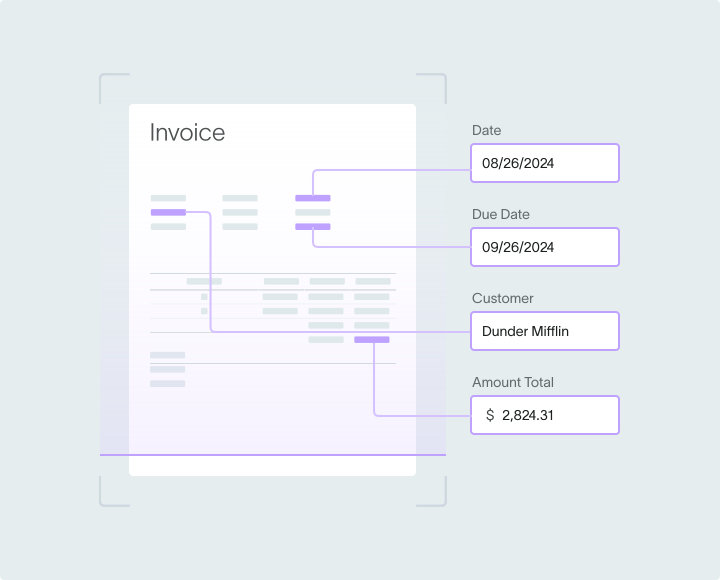
For AP, automation begins with intelligent invoice scanning. OCR technology and machine learning extract vendor details, line items, and payment terms with up to 99% accuracy. Once uploaded, AI performs three-way matching, detects duplicates, routes invoices for approval, and flags suspicious items for human review.
In AR, AI offers immense value through prediction and prioritization. It forecasts payment delays by analyzing customer payment histories, credit scores, and economic indicators to calculate default probabilities. Today’s tools then prioritize collections based on invoice value and likelihood of successful recovery, optimizing cash flow management.
Frequently Asked Questions About AI in Accounting
Q: What is generative AI in accounting?
A: Generative AI in accounting uses advanced models, like large language models (LLMs), to create new content, summarize complex information, and perform complex reasoning tasks. It goes beyond simple automation to draft reports, explain regulatory changes, and even generate financial analyses.
Q: How does AI help with data entry automation in accounting?
A: AI significantly automates data entry by using technologies like Optical Character Recognition (OCR) and intelligent document processing. It extracts information from invoices, receipts, and other documents, categorizes transactions, and populates financial systems with high accuracy, drastically reducing manual effort and errors.
Q: Can AI replace human accountants?
A: No, AI is designed to augment, not replace, human accountants. It automates repetitive, rules-based tasks, freeing up accountants to focus on strategic analysis, complex problem-solving, client advisory, and interpreting AI-generated insights. AI transforms the accountant’s role, making it more strategic and less clerical.
Q: What are the main challenges when implementing AI in accounting?
A: Key challenges include addressing skill gaps within teams, integrating AI with legacy accounting systems, ensuring high data quality, and managing internal resistance to change. Overcoming these requires proper training, flexible AI platforms, data governance, and thoughtful, phased implementation strategies.
Q: How quickly can businesses see benefits from AI in accounting?
A: Many businesses, especially SMEs using cloud-based AI solutions, can see benefits relatively quickly. Time savings from automated data entry and reporting can appear within weeks or months. Full integration across multiple functions, however, is a more gradual process leading to deeper, long-term strategic advantages.
Keywords: generative AI, data entry automation, AI in accounting, accounting automation, financial technology, LLMs in finance, payroll automation, tax compliance AI, audit AI, accounts payable automation