Generative AI tools like ChatGPT are rapidly transforming how businesses operate, and accounting is no exception. With hundreds of millions of users, this technology from OpenAI offers powerful capabilities that can significantly boost your team’s productivity. Imagine streamlining tasks, gaining deeper financial insights, and enhancing your decision-making processes with intelligent assistance.
At its core, ChatGPT is a large language model (LLM) leveraging natural language processing (NLP). It uses a chatbot interface to answer your queries, summarize documents, conduct research, and perform various AI tasks based on the prompts and files you provide.
What Makes ChatGPT a Game-Changer for Accountants?
ChatGPT acts as an automated AI tool, generating human-like text, images, or audio from your questions. Software applications can even integrate ChatGPT functionality via API, embedding its power directly into existing programs. This integration reduces manual effort, helps analyze trends, and identifies data anomalies, making accounting more efficient.
Understanding ChatGPT’s Current Limitations
While incredibly powerful, ChatGPT isn’t perfect. Its effectiveness largely depends on your ‘prompt engineering’ skills – how well you phrase your requests. Human oversight, fact-checking, and iterative refinement of its output remain crucial.
You should also avoid entering sensitive information, as OpenAI warns about privacy and security concerns. Additionally, the standard models have a knowledge cutoff date (e.g., GPT-4o trained up to September 2023), though newer ‘Search’ and ‘Deep Research’ features can access more current internet information, often requiring a paid subscription.
12 Smart Ways Accountants Can Use ChatGPT
Accountants can effectively integrate ChatGPT into various workflows, improving accuracy and saving valuable time. Here are twelve practical applications:
-
Invoice Processing
ChatGPT can assist with aspects of invoice processing, such as coding expenses. However, for full efficiency and accuracy, specialized AP automation software with embedded ChatGPT features, like Tipalti, offers a more robust solution. These integrated features enhance account coding predictions and improve purchase order matching.
-
Coding Expenses
While you can use ChatGPT directly to attempt coding expenses to your chart of accounts, dedicated AP automation software with built-in AI and ChatGPT features provides superior accuracy and efficiency. For example, Tipalti AP automation, combined with Tipalti Expenses, streamlines employee expense reimbursements and their coding, eliminating manual data entry and reducing payment errors by up to 66%.
-
Data Cleansing
Before migrating data or running reports, clean data is essential. ChatGPT excels at cleaning accounting data, such as removing unnecessary characters from customer names or eliminating duplicate entries in spreadsheets and master files.
-
Formatting Output
If your existing accounting software or ERP system’s report formatting isn’t ideal, ChatGPT can reformat financial statements, tables, and reports. You can input files and prompts to generate custom layouts or even CSV files for various uses. This tool can also efficiently sort data.
-
Report Narratives and Notes
Enhance your financial reports and statements by asking ChatGPT to generate narratives, notes, and even suggestions for profitability improvements. It can analyze significant changes in account balances across comparative periods. For formal ‘Notes to Financial Statements,’ ensure you fact-check and supplement with the latest GAAP or IFRS standards.
-
Generating Computer Code
Need a custom script or formula? ChatGPT can generate computer code in various languages like JavaScript, Python, R, or Excel macro code and formulas. If the code has errors, you can provide feedback, and ChatGPT will help revise it.
-
Data Analysis for Decision-Making
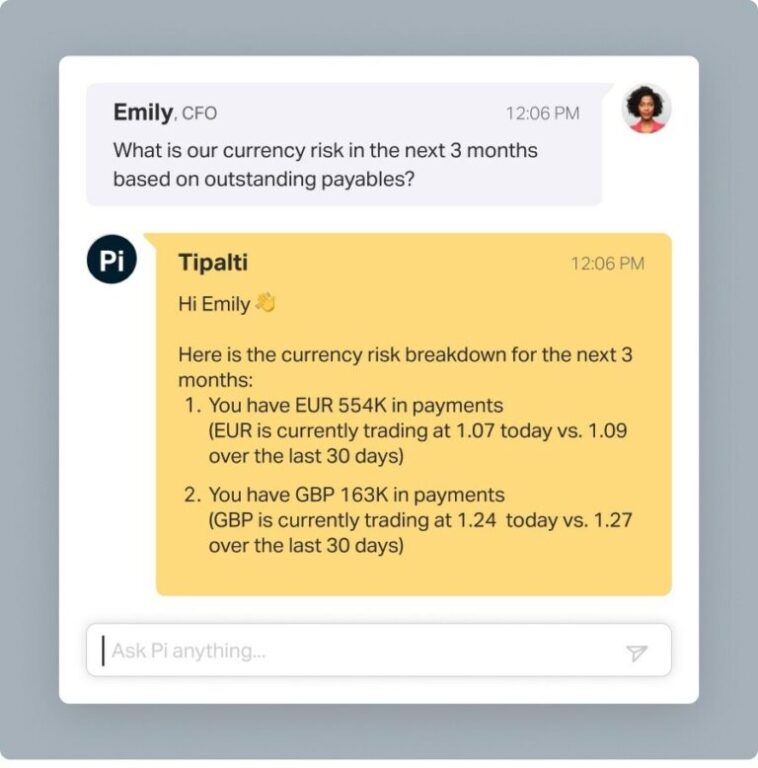
Leverage ChatGPT to analyze financial data and identify anomalies in trends, amounts, or percentage changes that warrant further investigation. These insights can highlight opportunities for operational improvements and cost reductions, boosting profitability. Tipalti’s ‘Ask Tipalti AI SM’ digital assistant, with its built-in ChatGPT features, provides real-time financial data insights and spend analysis.
-
Business Plan and Pitch Deck Research
When preparing a business plan or pitch deck, extensive research is crucial. ChatGPT can perform preliminary research, helping you brainstorm ideas and generate text. Remember to fact-check its output and provide up-to-date information as input, especially when using its ‘Search’ or ‘Deep Research’ features.
-
Preliminary Financial Forecasts and Budgets
ChatGPT can assist in generating preliminary demand predictions, financial forecasts, and budgets. However, these outputs require human judgment and adjustment to ensure accuracy and reflect real-world conditions.
-
Audits
External audits often involve analytical reviews to identify anomalies in financial data. ChatGPT can serve as a valuable aid in this process. Additionally, it can help internal accounting professionals prepare general ledger account reconciliation schedules for auditors, potentially reducing audit fees.
For example, you can ask ChatGPT to help you build a **checklist for ChatGPT for bank reconciliation**, ensuring all steps are covered and discrepancies are systematically addressed during an audit review.
-
Tax and Legislation Compliance Research
While not yet ready to prepare tax returns, ChatGPT excels at tax research and summarizing new legislation. You can use its ‘Search’ feature for internet searches or input PDF documents with legislative content to gain quick summaries and analysis.
-
Business Communications and Brainstorming
From drafting emails and reports to brainstorming new ideas, ChatGPT can be a powerful communication assistant. Provide prompts about your desired writing style, context, and tone, then review and revise its suggestions for accuracy and impact. Tools like GrammarlyGO, powered by ChatGPT, also offer enhanced editing capabilities.
Recent Advancements in ChatGPT Capabilities
OpenAI continuously releases new features, making ChatGPT even more versatile for accounting professionals:
- GPT-4 (March 2023): Introduced multimodal capabilities, allowing text and image inputs, and the ability to upload files.
- Plugin Support (March 2023): Enabled integration with third-party services, expanding functionality.
- Code Interpreter (July 2023): Provided data analysis, code execution, and file handling within the chat interface.
- Voice and Image Interaction (September 2023): Allowed users to engage with ChatGPT using voice and image inputs.
- DALL·E 3 Integration (October 2023): Enabled image generation based on user prompts.
- GPT-4 Turbo (November 2023): Offered a faster, more cost-effective version of GPT-4 with an expanded context window.
- GPT-4o (‘Omni’) (May 2024, updated March 2025): Enhanced multimodal interactions, processing text, audio, and images in real time with improved accuracy and understanding.
- Search (October 2024): Introduced the ability to search the internet for recent information, complete with web source links.
- Deep Research Tool (February 2025): Provided comprehensive, detailed research reports, initially for Pro users.
FAQs About ChatGPT in Accounting
Can ChatGPT automate all accounting tasks?
While ChatGPT significantly assists with many accounting tasks like coding and report generation, full automation, particularly for complex processes like accounts payable, often requires embedded AI tools within specialized software for accuracy, compliance, and scalability.
Is ChatGPT reliable for financial analysis?
ChatGPT can analyze financial data and identify trends or anomalies, offering valuable insights for decision-making. However, it requires human oversight, fact-checking, and careful prompt engineering to ensure the accuracy and relevance of its analysis.
How important is data privacy when using ChatGPT for accounting?
Data privacy is critical. OpenAI advises against entering sensitive information into ChatGPT directly. For confidential accounting data, integrating ChatGPT features within secure, specialized accounting software is a safer and more effective approach.
The Future of AI and Accounting
AI is not just the future; it’s the present of accounting and a key driver of digital transformation. The impact of ChatGPT on the accounting profession is immense, with AI models increasingly embedded into software programs. Companies like Intuit, with its partnership with OpenAI, are already integrating ChatGPT into products like TurboTax and QuickBooks, aiming to build secure, intelligent, and personalized GenAI experiences.
Automation is a finance department’s greatest asset, and AI, especially ChatGPT, sits at the forefront of this change. Embrace these technologies to future-proof your business and scale with growth.
Keywords: ChatGPT, AI in accounting, accounting automation, financial technology, bank reconciliation checklist, OpenAI, bookkeeping, data analysis, financial planning, digital transformation