Revolutionizing Finance: Your Guide to AI in Accounting
The financial world is undergoing a massive transformation, with artificial intelligence (AI) leading the charge. Once a futuristic concept, AI is now a core tool, automating tasks and providing deeper insights across accounting functions. Businesses are quickly adopting AI, recognizing its power to boost efficiency and accuracy.
Did you know the global AI accounting market is projected to hit $10.87 billion by 2026? Small and medium-sized enterprises (SMEs) are key drivers of this growth, with a staggering 44.6% compound annual growth rate (CAGR). This shift indicates AI is no longer just for large corporations; it’s becoming accessible to everyone.

What Exactly is AI in Accounting?
AI in accounting refers to using artificial intelligence to automate and enhance core financial functions. This ranges from simple data entry to complex reporting, audit support, and even predictive insights. It’s fundamentally moving the profession beyond traditional manual bookkeeping.
Its importance is undeniable: AI now delivers significant time savings, smarter reporting, and improved accuracy. Routine tasks are transforming into near real-time workflows, allowing finance professionals to focus on more strategic work.
Today, AI plays a crucial role in accelerating financial reporting, tracking cash flow, managing accounts payable and receivable (AP/AR), ensuring tax compliance, reconciling general ledgers, and testing controls. These areas, rich in structured data and clear rules, are perfect candidates for AI integration.
However, AI implementation isn’t without its limits. Legacy systems and poor data quality can slow down adoption. Human judgment also remains crucial for interpreting results, making compliance decisions, and understanding context. Looking ahead, generative and agentic AI promise even deeper automation, from drafting analyses to executing entire accounting workflows, making AI-native platforms essential for modern finance teams.
The Evolution of AI in Accounting: From Simple Rules to Smart Agents
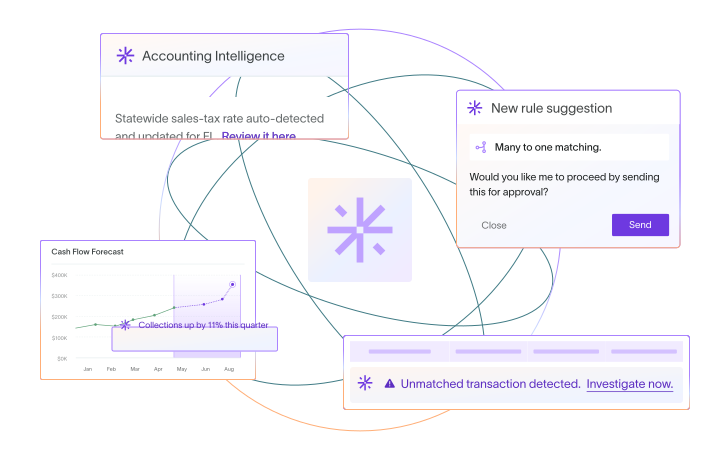
AI’s influence in accounting isn’t new; it began around 2015 with rules-based automation. This initial phase focused on processing structured data and basic machine learning, helping businesses automate data entry, categorize transactions simply, and match transactions based on predefined rules.
A significant leap occurred in 2023 with the advent of generative AI. Large Language Models (LLMs) allowed companies to move beyond just recognizing patterns. They could now generate content and perform complex reasoning, enabling automation of higher-order accounting functions that were previously impossible.
Today, AI is a powerful assistant for finance teams. It can draft reports, summarize regulatory changes, enforce compliance policies, and track cash flow patterns, often with minimal human intervention. This frees up valuable time for strategic analysis.
The future points to agentic AI, which will play an even larger role. Agentic systems can identify tasks, select the right tools, execute the job, and deliver the output in the desired format. This includes everything from preparing journal entries and conducting variance analysis to compiling management reports and commentaries.
Where AI is Making an Impact in Finance Right Now
Beyond accounting, AI offers broad applications across finance, including bankruptcy prediction, stock price forecasting, and portfolio optimization. It also supports anti-money laundering (AML) compliance and behavioral finance analysis, demonstrating its versatile reach.
For most organizations, AI is having its greatest impact on everyday accounting tasks. These foundational areas benefit immensely from AI because they involve high volumes of data and follow clear structures and rules, making the benefits easier to measure and the implementation path clearer.
Key Accounting Areas Benefiting from AI:
- Financial reporting and statement preparation
- Accounts payable (AP) and accounts receivable (AR) management
- Tax compliance and planning
- Audit workflows and controls testing
- General ledger (GL) maintenance and reconciliation
Enterprise Platforms and the Rise of AI-Native Solutions
Major enterprise resource planning (ERP) vendors like SAP, Oracle, and Microsoft are integrating AI into their existing systems. SAP, for instance, uses AI with semantic understanding to classify financial data, while Oracle employs autonomous database technology for automated tasks and predictive insights.
Microsoft has expanded Copilot across its Dynamics 365, Office apps, and Teams, allowing companies to leverage AI for financial reporting and approvals. This widespread adoption by tech giants highlights AI’s transition from a luxury to a necessity in finance.
However, simply embedding AI into legacy architecture has its limitations. These older systems restrict deep AI integration and require vendors to maintain backward compatibility. This is where AI-native accounting software platforms, built from the ground up with AI, offer a distinct advantage.
Platforms like DualEntry, designed around AI-powered accounting, automate workflows more intuitively and provide more intelligent insights than retrofitted enterprise systems. As businesses make long-term platform decisions, the difference between embedded AI and native AI architecture becomes increasingly significant.
The Current State of AI Adoption in Finance
AI adoption rates are rapidly climbing. A 2024 report by the Bank of England revealed that about 75% of UK financial services firms already use AI, with another 10% planning to implement it within the next three years. This demonstrates a clear trend toward widespread AI integration.
Companies typically fall into different maturity tiers based on their AI integration depth. KPMG’s Global AI in Finance Report identifies three groups: Leaders (24%), who have AI embedded across multiple processes and see the biggest gains; Implementers (58%), who use AI in specific functions but lack full integration; and Beginners (18%), who are still in pilot or early-stage deployments.
Advancing through these tiers leads to significant performance improvements. Leaders achieve 87% adoption at scale, while implementers report moderate to emerging use cases. Organizations moving from early experimentation to mature AI strategies are experiencing substantial productivity gains across various functions.
SMEs Are Driving the Next Wave of AI Adoption
Small and medium-sized enterprises (SMEs) are significantly increasing their investment in AI for accounting. This major market shift is largely due to enhanced accessibility. Cloud infrastructure, application programming interfaces (APIs), and subscription pricing models have made advanced AI more affordable and easier to adopt.
Not long ago, advanced AI was an enterprise-only advantage, requiring substantial capital and technical resources. Now, smaller firms can access enterprise-grade AI through user-friendly no-code and low-code platforms. Plug-and-play integrations allow for AI deployment without dedicated IT support.
This goes beyond basic automation; SMEs are already using AI for sophisticated workflows like automated financial reporting, intelligent document processing, predictive cash flow analysis, and real-time anomaly detection. These tools, once costing millions to build, are now available via cloud-based platforms and monthly subscriptions, enabling small accounting practices to achieve automation levels comparable to much larger competitors.
Overcoming Barriers to AI Implementation in Finance
Despite the rapid adoption, implementing AI in accounting isn’t always straightforward. Most companies encounter common roadblocks, including skill gaps within teams (affecting 58% of finance departments), limitations of legacy systems, data quality issues (causing 63% of early project delays), and internal resistance to change.
Skill gaps are often the initial hurdles, as finance workers need new capabilities to manage AI tools and interpret their outputs. Legacy systems, like NetSuite, can impede progress by lacking support for modern AI integrations. Inconsistent or incomplete data also leads to unreliable AI outputs, making data quality a critical factor.
Successful companies address these challenges effectively through strategies such as vendor-managed implementations that include training programs and technical support. They also prioritize user-friendly tools that don’t require IT or coding expertise, and implement phased rollouts to ensure gradual adoption and minimize disruption.
Businesses that thoughtfully tackle these barriers are more likely to achieve higher implementation success rates. Leveraging external support and adopting a structured rollout process can significantly reduce risks and help overcome early obstacles.
AI in Action: Key Use Cases Across Accounting

Financial Statements
AI significantly transforms the preparation of financial statements, reducing the heavy lifting of data collection and processing. Systems can directly pull information from general ledgers, trial balances, and journal entries. Machine learning maps transactions to the correct line items, while natural language processing (NLP) interprets and applies accounting policies.
Properly implemented AI tools achieve over 95% accuracy in preparing standard financial statements. They also proactively flag missing entries, classification errors, and unusual balances. Intelligent document processing extracts supporting details from invoices, contracts, and bank statements, allowing AI agents to compile draft statements that adhere to relevant accounting standards.
This operational impact is enormous. Monthly close cycles can shrink from weeks to days, with many companies moving towards daily or real-time reporting. Internal stakeholders receive more frequent performance updates, and external reporting becomes more transparent and timely. Automation also minimizes manual compilation errors and ensures consistent reporting across periods.
Forecasting and Planning
AI is also reshaping management accounting, particularly in forecasting, planning, and analysis. It automates variance analysis by comparing actual results against budgets and highlighting major deviations. Furthermore, AI runs cost-benefit analyses using historical patterns and predictive modeling, setting up rolling forecasts that automatically update with new transaction data.
AI also handles predictive cash flow models, incorporating variables like seasonality or payment history, and continuously improves forecasting accuracy by adjusting predictions based on actual outcomes. As a result, planning cycles that once took weeks now take hours or less, and forecasting accuracy can improve by 30-50% compared to traditional methods.
Leadership teams benefit from real-time scenario modeling, allowing them to test assumptions instantly. Strategic planning becomes more robust, supported by the most up-to-date financial data and insights.
Payroll Accounting
Payroll is an area where AI truly shines, especially for companies operating in multiple jurisdictions. AI streamlines the entire process by automatically pulling and processing data using OCR technology. This eliminates manual data entry for timesheets, payroll registers, and tax forms, regardless of whether they are handwritten, digital, or scanned.
Automation also handles the complex calculation of gross pay, deductions, tax rates, and compliance rules based on relevant regulatory requirements. This is particularly valuable for multi-state and international payrolls. Organizations implementing AI-powered payroll systems achieve 60-80% reductions in processing errors through automated validation and real-time compliance checking.
Compliance violations significantly decrease because systems stay updated with regulatory changes, and manual intervention drops by up to 70%. Organizations can run payroll for thousands of employees across dozens of jurisdictions simultaneously, enabling smaller teams to manage larger, more complex payroll setups efficiently.
Tax Accounting
Tax workflows are another excellent fit for AI, primarily due to their document-heavy and rules-based nature. AI-powered document parsing processes tax returns, receipts, and forms like W-2s and 1099s at scale. Intelligent document processing extracts data from supporting schedules, and machine learning assists with expense categorization and deduction identification.
In practice, AI can automate a significant portion of tax preparation, with research suggesting over 80% of individual tax return preparation can be automated. Platforms can handle data gathering and populate required tax forms, optimize deductions, and consistently apply tax rules. They efficiently process thousands of transactions, which is particularly helpful for corporate tax returns, and maintain audit trails with full documentation for every tax position.
Overall, AI cuts tax preparation time by up to 65%. It also enhances compliance and helps uncover planning opportunities that manual processes often miss, leading to more strategic tax outcomes.
Auditing: How to use machine learning tools for audit preparation
AI is fundamentally transforming auditing by enabling auditors to review every single transaction, rather than just a sample. Instead of testing 5-10% of activity, auditors can now conduct 100% population reviews. This comprehensive approach significantly enhances audit quality and coverage.
To understand how to use machine learning tools for audit preparation, consider this: Machine learning algorithms scan millions of transactions rapidly, flagging anomalies by vendor, amount, time period, and frequency. They can pinpoint duplicate payments, round-dollar transactions, and entries posted outside normal business hours. Statistical models further identify outliers that deviate from expected behavioral patterns, providing auditors with a powerful initial analysis.
AI-native tools enhance professional judgment rather than replacing it. The technology efficiently handles data-heavy scanning and anomaly detection, allowing auditors to focus on interpreting results and investigating exceptions. This shift frees up auditors for more higher-value advisory work, making the audit process more strategic and insightful.
Accounts Payable (AP) and Accounts Receivable (AR)
Accounts payable (AP) and accounts receivable (AR) processes become significantly faster and more efficient when AI takes over document handling, workflow routing, and risk detection. This automation minimizes manual effort and accelerates financial cycles.
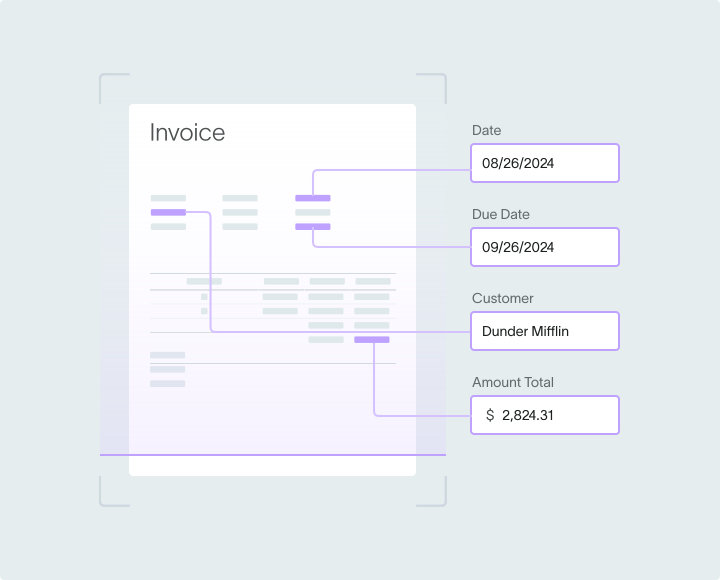
On the AP side, automation begins with intelligent invoice scanning. OCR technology and machine learning extract vendor details, line items, and payment terms with impressive accuracy rates, often reaching 99%. Once this data is uploaded into the ERP, AI can handle three-way matching between purchase orders, receiving documents, and invoices.
AI also detects any duplicate invoices and routes them through the correct approval workflows. Crucially, it flags suspicious items, like unusual vendor information or payment instructions, for human review, preventing potential fraud. In AR, the value of this new technology lies in prediction and prioritization. AI forecasts payment delays by analyzing customer payment histories, credit scores, and economic indicators to calculate default probabilities, allowing teams to proactively address potential issues.
Frequently Asked Questions About AI in Accounting
- What are the primary benefits of using AI in accounting?
- AI in accounting offers numerous benefits, including increased efficiency through automation, enhanced accuracy in data processing, improved compliance, better fraud detection, and deeper insights for strategic decision-making. It frees up accounting professionals from mundane tasks, allowing them to focus on higher-value activities.
- How does AI help with audit preparation?
- AI significantly helps with audit preparation by enabling 100% population reviews of transactions, rather than just sampling. Machine learning tools identify anomalies, duplicate payments, and unusual entries across millions of data points. This allows auditors to quickly pinpoint areas requiring human investigation, leading to more thorough and efficient audits.
- What are the main challenges when implementing AI in an accounting firm?
- Key challenges include skill gaps within accounting teams, limitations of legacy systems that may not integrate well with modern AI, ensuring high data quality for reliable AI outputs, and overcoming internal resistance to change among staff. Addressing these requires strategic planning, training, and robust IT infrastructure.
- Can AI replace human accountants?
- No, AI is designed to augment, not replace, human accountants. While AI automates repetitive and data-heavy tasks, human judgment, ethical reasoning, strategic thinking, and client relationship management remain indispensable. AI empowers accountants to become more strategic advisors by handling the routine work.
- How is generative AI different from traditional machine learning in accounting?
- Traditional machine learning focuses on pattern recognition and rules-based automation for structured data. Generative AI, utilizing large language models (LLMs), goes further by generating content, performing complex reasoning, and automating higher-order functions like drafting reports or summarizing regulatory changes, capabilities not possible with older systems.
Keywords: AI in accounting, machine learning audit, audit preparation tools, accounting automation, financial AI, generative AI accounting, agentic AI, accounting technology, financial reporting AI, tax accounting AI