The global accounting market is experiencing a significant transformation, with artificial intelligence (AI) at its forefront. Projections indicate the AI accounting market will hit an impressive $10.87 billion by 2026, driven largely by rapid adoption among small and medium-sized enterprises (SMEs). This profound shift means accounting professionals are moving beyond manual tasks to focus on more strategic, analytical work.
If you’re looking for a beginner’s guide to machine learning tools for data entry automation, you’ve come to the right place. AI is fundamentally reshaping how we approach core finance functions, making workflows faster, more accurate, and far more insightful.
The Evolution of AI in Accounting
AI’s influence in accounting isn’t entirely new; its impact began around 2015 with rules-based automation. This initial phase focused on processing structured data and basic machine learning algorithms. Companies started exploring options for automated data entry, simple categorization tasks, and rule-based transaction matching.
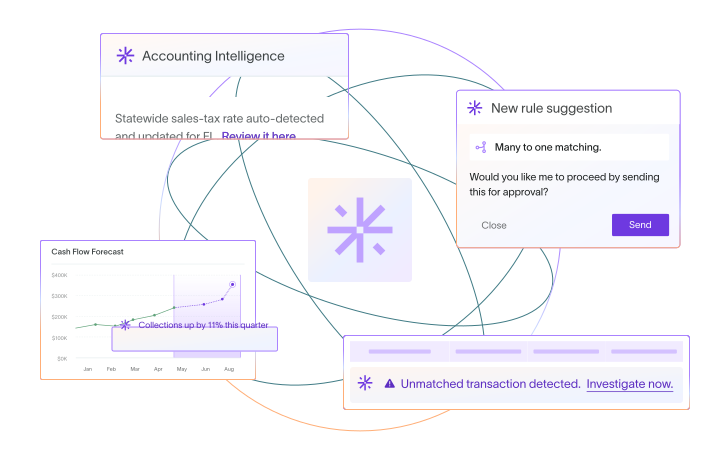
The landscape shifted dramatically in 2023 with the arrival of generative AI. Large Language Models (LLMs) moved beyond simple pattern recognition, enabling content generation and complex reasoning. This represented a “quantum leap” in capabilities, automating higher-order accounting functions previously impossible with rule-based systems. Today, AI helps draft reports, summarize regulatory changes, enforce compliance policies, and track cash flow patterns without extensive human intervention.
The future points towards agentic AI, which will play an even bigger role. These systems will plan and execute entire accounting workflows automatically, from preparing journal entries and tackling variance analysis to putting together comprehensive reports and commentaries for management.
Why AI is a Game-Changer for Accounting
AI’s adoption has moved beyond mere experimentation. It now delivers measurable time savings, smarter reporting, and significantly higher accuracy. Routine tasks are transforming into near-real-time workflows. For instance, some firms report over 80% automation in individual tax return preparation, while audit and advisory teams reduce document analysis time by 50% or more through AI-powered research tools. This allows finance professionals to dedicate more time to strategic insights and less to repetitive manual labor.
AI’s Core Impact: Automating Data Entry
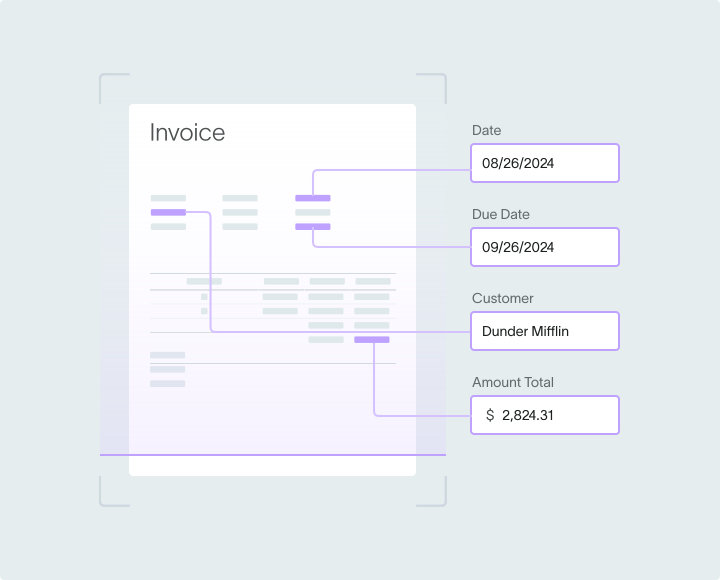
One of AI’s most impactful applications in accounting is the automation of data entry. Machine learning tools excel at processing high volumes of data and adhering to clear structures and rules. This makes them perfectly suited for tasks like extracting details from invoices, receipts, contracts, and bank statements.
These tools can automatically categorize transactions, match data across various documents, and even flag discrepancies for human review. For beginners, understanding how these machine learning tools streamline data input is crucial. They not only save immense time and operational costs but also drastically reduce human errors, forming the foundation for more advanced AI applications in finance.
Key Use Cases of AI in Accounting
AI’s widespread impact is evident across numerous everyday accounting functions, optimizing processes and providing deeper insights.

- Financial Reporting: AI simplifies financial statement preparation by gathering data directly from general ledgers, trial balances, and journal entries. It maps transactions to correct line items and interprets accounting policies. AI-native systems can generate income statements, balance sheets, and cash flow statements with minimal human involvement, achieving over 95% accuracy and flagging issues like missing entries or classification errors. Monthly close cycles can shrink from weeks to mere days.
- Forecasting and Planning: Management accounting benefits significantly. AI automates variance analysis, comparing actual results against budgets. It runs cost-benefit analyses using historical patterns and predictive modeling. AI can set up rolling forecasts that update automatically and handle predictive cash flow models, leading to 30-50% more accurate predictions. This enables leadership teams to test assumptions instantly and make more robust strategic plans.
- Payroll Accounting: Payroll is a clear area where AI shines, especially for companies operating in multiple jurisdictions. AI streamlines everything by pulling and processing data automatically with OCR technology. It handles calculations of gross pay, deductions, tax rates, and compliance rules based on relevant regulatory requirements. Organizations implementing AI-powered payroll systems achieve 60-80% reductions in processing errors and can manage complex payroll setups for thousands of employees with smaller teams.
- Tax Accounting: Tax workflows are an excellent match for AI due to their document-heavy and rules-based nature. AI-powered document parsing processes tax returns, receipts, and forms like W-2s and 1099s at scale. Machine learning assists with expense categorization and deduction identification. Research suggests that over 80% of individual tax-return preparation can be automated, cutting overall preparation time by up to 65% and improving compliance.
- Auditing: AI transforms auditing by making it possible to review every single transaction, rather than just a sample. Machine learning algorithms scan millions of transactions to flag anomalies by vendor, amount, time period, and frequency. They can spot duplicate payments, round-dollar transactions, or entries posted outside normal business hours. AI-native tools enhance professional judgment, allowing auditors more time for higher-value advisory work.
- Accounts Payable (AP) & Accounts Receivable (AR): AI accelerates AP and AR processes by taking over document handling, workflow routing, and risk detection. For AP, intelligent invoice scanning and OCR technology extract vendor details, line items, and payment terms with up to 99% accuracy. AI then handles three-way matching, detects duplicates, routes invoices for approval, and flags suspicious activities. In AR, AI can forecast payment delays by analyzing customer payment histories and prioritize collections based on invoice value.
AI-Native vs. Embedded Systems
Many major Enterprise Resource Planning (ERP) vendors, like SAP and Oracle, have started embedding AI directly into their existing systems. While this offers some automation, these capabilities are often “bolted onto” legacy architecture that was built long before modern AI development took off. This older design restricts how deeply AI can be integrated and requires vendors to maintain backward compatibility with older modules and workflows.

In contrast, AI-native platforms are built from the ground up with AI at their core. This foundational design allows for more intuitive workflow automation and deeper, more intelligent insights from day one. As businesses think through long-term platform decisions, the difference between retrofitted and natively integrated AI is becoming increasingly significant.
Who’s Adopting AI? Everyone, Especially SMEs
AI adoption is rapidly increasing across financial services. A Bank of England report indicates that around 75% of UK financial firms already use AI, with another 10% planning implementation within the next three years.
Companies typically fall into different maturity tiers: Leaders (24%) deeply embed AI across multiple processes, Implementers (58%) roll out AI in specific functions, and Beginners (18%) are still in pilots or early-stage deployments. Moving up these tiers yields significant performance improvements.
Notably, SMEs are driving the next wave of AI investment in accounting, with their adoption propelling market growth at a 44.6% CAGR. Cloud infrastructure, application programming interfaces (APIs), and subscription pricing models have made advanced AI more accessible to smaller firms. This allows them to achieve automation levels comparable to, or even exceeding, much larger competitors.
Navigating the Hurdles of AI Implementation
Despite rapid adoption, implementing AI in accounting presents common roadblocks. These often include skill gaps within teams (affecting 58% of finance departments), limitations of legacy systems, data quality issues (causing 63% of early project delays), and internal resistance to change.
Finance professionals need to acquire new skills to manage AI tools and interpret their outputs effectively. Legacy systems can also slow progress if they do not support the integrations modern AI deployments depend on. Inconsistent or incomplete data creates unreliable outputs. Internal resistance is common, often stemming from concerns about job displacement or disrupting existing workflows.
Successful companies address these challenges thoughtfully. They often opt for vendor-managed implementations that include comprehensive training programs and technical support. Choosing tools that are easy to use and don’t require extensive IT or coding expertise is also crucial. Phased rollouts allow for gradual adoption, cutting risk and helping to overcome early obstacles.
Frequently Asked Questions (FAQ)
Q1: What are machine learning tools for data entry automation in accounting?
A1: These tools use algorithms to automatically extract, categorize, and process financial data from various sources like invoices, receipts, and bank statements. They minimize manual input, reduce errors, and streamline foundational accounting tasks.
Q2: How does AI benefit small and medium-sized enterprises (SMEs) in accounting?
A2: AI offers SMEs access to sophisticated automation for tasks like financial reporting, predictive cash flow analysis, and anomaly detection. Cloud-based platforms and subscription models make these enterprise-grade tools affordable and accessible, leveling the playing field with larger competitors.
Q3: What are the main challenges when implementing AI in accounting?
A3: Common challenges include a lack of necessary skills within finance teams, limitations imposed by outdated legacy systems, issues with data quality, and resistance to change among employees. Addressing these requires strategic planning and support.
Q4: Can AI replace human accountants?
A4: AI automates repetitive and data-heavy tasks, freeing accountants to focus on strategic analysis, interpretation, and advisory roles. It enhances human judgment rather than replacing it, transforming the profession towards higher-value activities.
Keywords: machine learning, data entry automation, AI in accounting, accounting tools, finance automation, generative AI, agentic AI, SME accounting, digital transformation, financial technology