Your Beginner’s Guide to Machine Learning Tools for Bank Reconciliation and Beyond
Are you an accounting professional navigating the rapidly evolving digital landscape? Artificial intelligence (AI) is transforming the accounting world, moving far beyond simple automation. This guide explores how advanced AI, including specific machine learning tools, can revolutionize key financial processes, particularly bank reconciliation, helping your firm achieve unprecedented efficiency and accuracy.
Modern accounting firms face a unique challenge: while AI-powered software appears everywhere from invoice capture to report drafting, many teams still grapple with manual tasks and lengthy closing times. The real breakthrough isn’t just improving individual steps, but achieving continuous, end-to-end execution across complex workflows. This is where agentic AI steps in.
The Evolving Landscape of AI in Accounting
AI adoption in accounting isn’t uniform, but its capabilities are rapidly advancing. Most finance teams currently use AI for routine, isolated tasks rather than comprehensive processes. Let’s look at how AI has evolved:
The first widespread wave of AI in accounting focused on document processing. Optical Character Recognition (OCR) tools helped accounts payable teams extract invoice data, classify fields, and significantly reduce manual effort. While these tools offered a meaningful leap over manual data entry, they primarily solved the intake problem, not the complex follow-through of exceptions.
The next generation leverages generative and agentic AI. These sophisticated models can summarize contracts, suggest categorizations, generate variance commentary, and even help accounting professionals prepare financial reports autonomously. Studies show that firms using these AI tools not only reallocate time to higher-value work but also improve financial statement granularity and shorten close timelines.
Today, AI software typically falls into three categories:
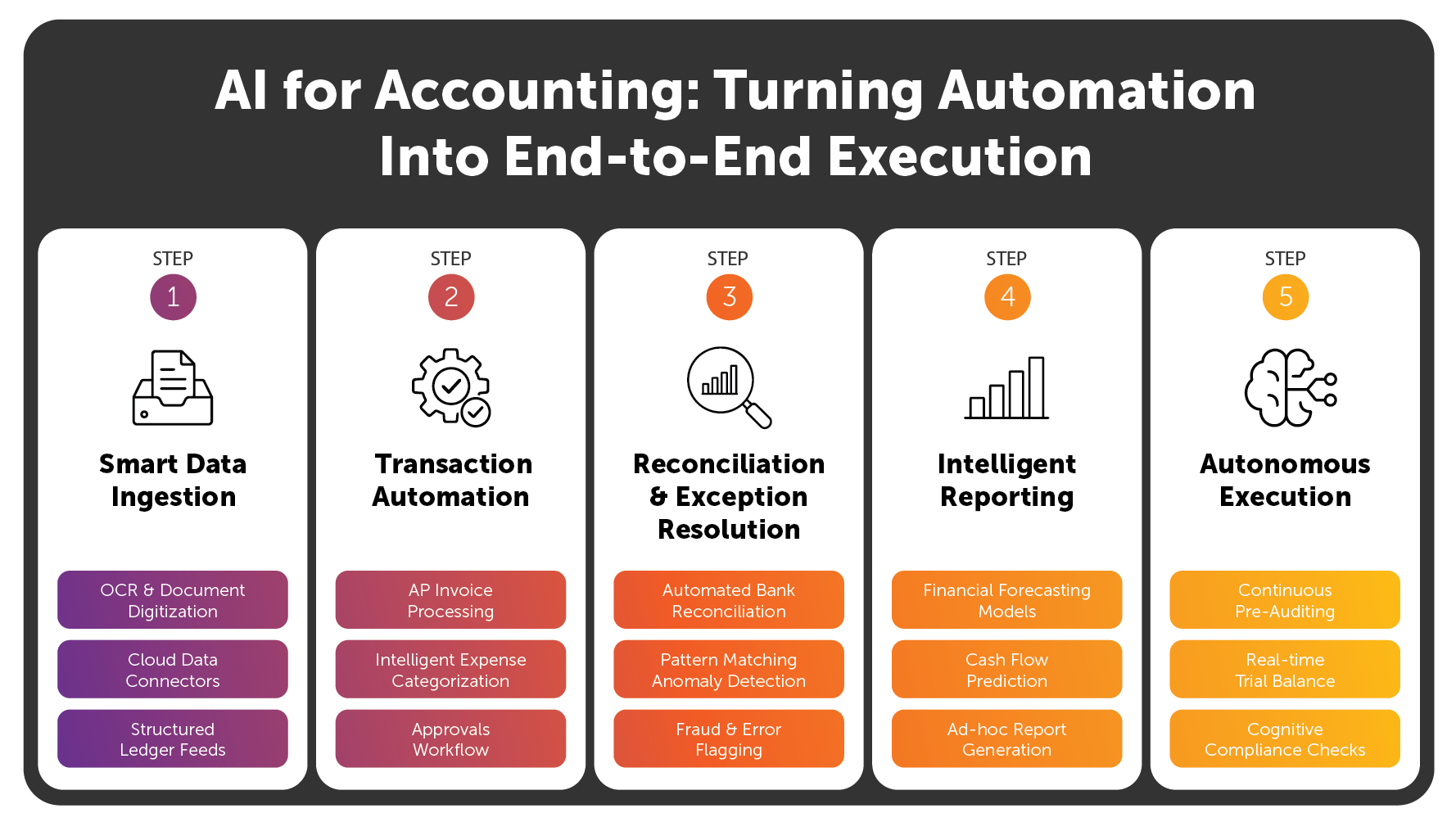
- Automation Tools: These task-based systems and bots assist with invoice coding, expense categorization, and data entry. They excel at repetitive work but often stop when tasks deviate from established patterns.
- Generative AI: These models draft reports, summarize account activity, and help create commentary or audit responses. They offer speed and convenience, but the user still manages the subsequent steps.
- Agentic or Predictive AI: This is where accounting AI truly begins to reason about policies, decide on next actions, and proactively advance workflows. Agentic intelligence becomes immensely valuable when connected to an execution layer that spans across various accounting systems, bank portals, documents, emails, and approval processes.
Bridging the Gap: From Task Automation to Autonomous Execution
Many traditional AI-powered tools fall short because they optimize individual steps without connecting them into a seamless, end-to-end process. Accounting performance, however, heavily relies on what happens between these steps. Imagine a reconciliation process that starts today, pauses for tomorrow’s bank file, waits for an internal confirmation on Friday, and then resumes next week when a new discrepancy arises. This is a living, ‘stateful’ process, not a one-off interaction.
A ‘stateful’ accounting agent remembers prior actions, tracks open items, understands conditions it’s waiting for, and knows what to do next when those conditions are met. This ‘act-wait-resume’ pattern distinguishes a mere assistant from a worker capable of autonomously executing a full process. Furthermore, accounting teams rarely operate within a single system; ledgers are in ERPs, cash evidence in bank portals, and approvals often reside in email or shared folders. AI integrated into only one application cannot oversee or govern the entire chain, leading to persistent coordination issues.
The Measurable Benefits of AI in Accounting
Even with previous limitations, finance leaders are increasing AI implementation because the economic advantages are compelling:
- Operational Efficiency: AI for accounting dramatically shortens intake, improves classification, and accelerates review work. Some reports show monthly close times falling by as much as 7.5 days.
- Accuracy and Risk Reduction: Manual accounting work is prone to errors. OCR and intelligent document processing significantly reduce keying mistakes. Agentic validation logic and policy-aware automation software help verify extracted information, pushing teams closer to finance-grade accuracy.
- Cost Savings: Finance leaders often see a 30-40% drop in labor costs per transaction. Agentic workflow automation for finance leads to higher straight-through processing, faster close operations, and lower costs across the accounting function.
- The Advisory Shift: As repetitive accounting work becomes automated, staff can dedicate more time to analysis, client service, and strategic decision support. This allows qualified professionals more room for expert judgment, transforming their roles.
Will AI Replace Accountants? No, It Will Transform Their Roles
The better question isn’t whether AI will replace accountants, but rather which accounting tasks should be automated and which should remain human-centric. AI excels at transcription, extraction, comparison, and summarization, moving accounting professionals up the value chain. Instead of spending hours on data collection and status chasing, CPAs can focus on policy interpretation, tax preparation, and business communication, evolving into more analytical and supervisory roles.
However, we must approach AI with caution. Finance teams cannot treat opaque AI output as inherently safe. Bad advice in accounting can lead to control failures or audit exposure. The controller of the future will become the architect of how work is executed under control, deciding where AI can operate autonomously, where human approvals are essential, and how exceptions should escalate. Humans will retain ultimate judgment, while AI expands the organization’s capacity to execute consistently.
High-Impact AI Use Cases in Accounting
AI delivers the strongest return on investment in areas where follow-through is as crucial as initial detection. Here are some high-impact applications:
-
Exception Resolution: Task-based AI can suggest an invoice code. Agentic AI goes further in procure-to-pay automation by detecting a missing purchase order, requesting clarification from the vendor or buyer, routing the invoice for the correct approval, waiting for a response, and then resuming the workflow once the exception resolves.
-
Beginner’s guide to machine learning tools for bank reconciliation follow-up and aging management: Traditional reconciliation tools are excellent at matching transactions. However, the greater challenge often lies in unresolved items that linger for days or weeks. Agentic workflows, powered by machine learning, move into the investigation phase. They can gather missing statements, compare supporting records, escalate issues based on amount or age, and keep items moving until variances are either cleared or approved for further action. This greatly enhances the efficiency and accuracy of managing outstanding reconciliation items.
-
Month-End Close Coordination: The month-end close is a complex dependency management problem. Agentic coordination helps track blocked tasks, notify stakeholders when prerequisites are complete, and maintain visibility across fragmented accounting software environments, streamlining the entire closing process.
Selecting the Right AI Software and Tools for Accounting
Not all AI in accounting is designed for enterprise-level execution. Your selection criteria should reflect finance’s stringent control requirements, not just user convenience. Look for enterprise-grade AI tools that offer security certifications like SOC 2 and ISO 27001, along with robust role-based access, audit logging, and compatibility with your existing ERP and finance stack.
Consider the difference between built-in AI (like in QuickBooks or Xero) and orchestration platforms. Built-in AI is useful for problems confined within a single application, assisting with categorization or summaries. Orchestration platforms become vital when processes span multiple systems and demand waiting, approvals, and a defensible execution history. Teams often find that even after adopting embedded AI, they still need a comprehensive execution layer.
Governance, Security, and Risk Management in AI
Accounting AI only scales effectively if governance is embedded into its execution, rather than an afterthought. This prevents ‘black box’ accounting, where accountants don’t understand how the AI arrived at a decision. Finance requires full explainability: knowing what the AI did, why, which policy it used, and what information supported its decision. This is fundamental to a robust control model.
Building an immutable audit trail for AI-driven transactions is also crucial. Audit readiness improves when all actions, approvals, and supporting evidence are captured as the work unfolds. Furthermore, a ‘human-in-the-loop’ (HITL) approach is essential. Sensitive actions like postings, write-offs, or payments should always require manual approval, preserving accountability while allowing AI to handle preparation, routing, and follow-through.
Conclusion: Moving Toward an Autonomous Finance Function
The ultimate goal of AI in accounting isn’t merely more tools; it’s extending controlled execution across the entire workflow. This represents a significant leap from fragmented task automation to autonomous department execution. Accounting processes often stall between systems, people, and periods, not because systems lack insight. Organizations that bridge this gap will operate faster, with enhanced embedded control, greater visibility, and significantly less manual coordination.
The future of AI in accounting belongs to systems that can act, wait, and resume, carrying work from detection to resolution while maintaining stringent controls and auditability. This vision moves accounting closer to a truly autonomous finance function.
Frequently Asked Questions (FAQs)
How do machine learning tools improve the accuracy of bank reconciliation?
Machine learning tools enhance bank reconciliation accuracy by consistently extracting data, identifying anomalies much earlier, and helping teams validate transactions before reporting deadlines. These tools can learn from historical data to recognize patterns, flag suspicious items, and even suggest resolutions, significantly reducing manual errors and speeding up the reconciliation process.
Can AI software work with legacy ERPs that lack modern APIs?
Yes, enterprise automation platforms often combine APIs with file-based integration and UI automation to interact effectively with older systems. This capability is vital in accounting, as many critical workflows still involve legacy ERPs, bank portals, spreadsheets, and document repositories that don’t offer modern interfaces.
How does AI contribute to faster month-end close times?
AI contributes to faster month-end closes by automating data extraction, improving classification, and accelerating review processes that traditionally consumed days. By handling repetitive tasks and identifying discrepancies proactively, AI allows accounting teams to validate transactions and complete reports more quickly and accurately.
What does ‘stateful’ AI mean in the context of accounting?
‘Stateful’ AI in accounting refers to an intelligent agent that can remember the context and progress of a multi-step process over time. Unlike ‘stateless’ AI, which only responds to immediate prompts, stateful AI can act, wait for external conditions (like a bank response), and then resume a task without losing its place, making it ideal for complex, ongoing accounting workflows like reconciliations.
Keywords: AI in accounting, machine learning for finance, bank reconciliation tools, accounting automation, agentic AI, finance digital transformation, month-end close automation, ERP integration, accounting software, financial efficiency