ChatGPT, a generative AI tool, has rapidly gained immense popularity, reportedly boasting over 400 million users by February 2025. This impressive adoption highlights its potential across various sectors, including finance and accounting. For businesses looking to boost productivity and refine financial processes, leveraging ChatGPT offers a promising avenue. This article explores practical ways accountants and financial professionals can integrate ChatGPT into their daily operations, from streamlining tasks to enhancing strategic decision-making.
At its core, ChatGPT is a sophisticated generative AI large language model (LLM) developed by OpenAI. It harnesses natural language processing (NLP) through a deep learning neural network to understand and generate human-like text. Users interact with ChatGPT by submitting prompts or questions, and in return, it produces relevant text, images, or even audio, functioning as a highly advanced conversational AI. This technology can also integrate into various software applications via API, extending its capabilities.
Current Limitations of ChatGPT
While incredibly powerful, ChatGPT isn’t without its limitations. Its effectiveness largely depends on the quality of your prompts and your ability to refine them. Human oversight remains critical; always fact-check and verify ChatGPT’s outputs, especially for financial accuracy. Furthermore, be cautious about inputting sensitive company data due to ongoing privacy and security concerns. Keep in mind that its training data has a cut-off date (e.g., September 2023 for GPT-4o), meaning it may not have the most current information unless you use its search features or provide recent data directly.
How to Effectively Use ChatGPT for Accounting
Integrating ChatGPT thoughtfully into accounting workflows can significantly enhance efficiency and insight. Here are twelve practical applications where this AI tool can support financial professionals.
1. Invoice Processing
Automating invoice processing is a significant area where ChatGPT can offer support. While you might use it for basic tasks like expense coding, dedicated AP automation platforms often provide greater accuracy and efficiency. Solutions like Tipalti, which integrate ChatGPT features, significantly enhance account coding predictions and improve purchase order matching for a seamless workflow.
2. Coding Expenses
Manually coding expenses with ChatGPT alone can be time-consuming and prone to errors. For more reliable results, consider using AP automation software with embedded AI, such as Tipalti. Its built-in ChatGPT capabilities automatically code supplier invoices, drastically reducing manual data entry and human errors. This digital transformation streamlines workflows, saving significant time and boosting efficiency.
3. Data Cleansing
Ensuring clean and accurate data is paramount, especially before migrating to new accounting systems. ChatGPT can assist with data cleansing tasks, such as removing unwanted characters from customer names or identifying and eliminating duplicate entries in spreadsheets. This helps maintain data integrity across your accounting software and master files.
4. Formatting Output
ChatGPT can also help you reformat financial statements, reports, and other accounting outputs. If your ERP system’s default formatting isn’t ideal, you can provide ChatGPT with the data to generate tables or CSV files in a preferred layout. While it excels at sorting and presentation, remember that ChatGPT is not designed to create full financial statements directly from raw transactions; your dedicated accounting software remains essential for that core function. Applying best practices for ChatGPT for financial statements here means using it for presentation and structure, not for primary generation or validation.
5. Report Narratives and Notes
Generating clear and insightful narratives for financial reports and statements becomes easier with ChatGPT. It can analyze changes in account balances, revenues, expenses, and profitability across periods, providing context and even suggesting improvements for internal reports. When preparing formal Notes to Financial Statements, using best practices for ChatGPT for financial statements is crucial; always fact-check its output and ensure compliance with the latest GAAP or IFRS standards. Public company CFOs can also leverage ChatGPT to analyze results and draft conference call scripts, even anticipating analyst questions.
6. Generating Computer Code
Accountants can also leverage ChatGPT for generating computer code. Specify your desired language, such as Python, JavaScript, R, or even Excel macros and formulas, and ChatGPT can produce the necessary script. If the code encounters errors or needs adjustments, simply describe the issue, and ChatGPT can help revise it. Copy and paste the generated code into your application, then perform any additional steps required.
7. Data Analysis for Decision-Making
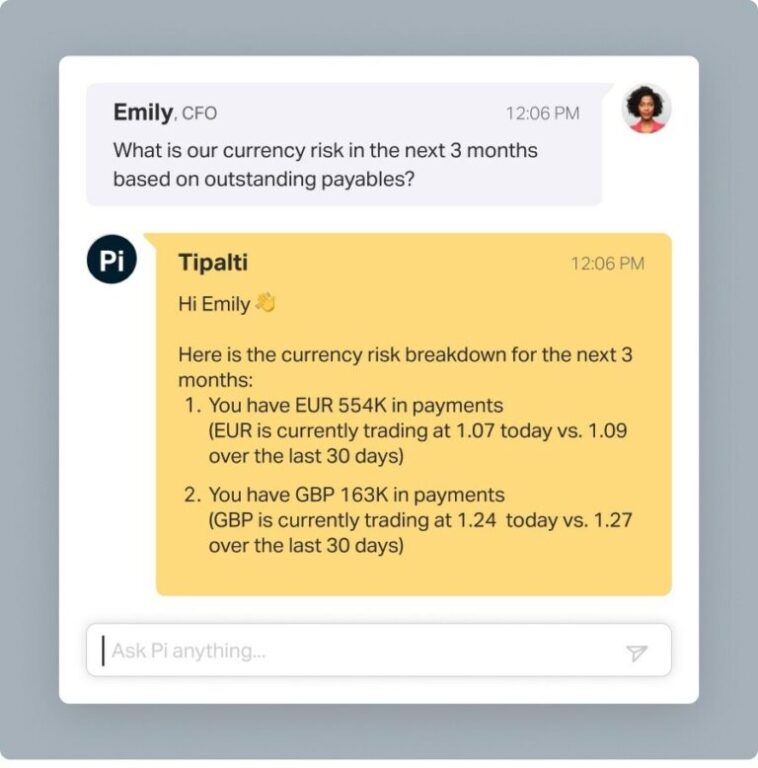
For strategic decision-making, ChatGPT offers powerful data analysis capabilities. It can review financial data to identify anomalies, unusual trends, or significant percentage changes that warrant closer inspection. These insights can pinpoint areas for operational improvements, potentially leading to cost reductions and enhanced business profitability. Furthermore, integrated solutions like Tipalti’s ‘Ask Tipalti AI SM’ provide real-time financial data insights and spend analysis.
8. Business Plan and Pitch Deck Research
Developing a robust business plan or a compelling pitch deck demands thorough research. ChatGPT can conduct preliminary research, generating ideas, text, and even images to support your presentation. Always fact-check its findings and utilize its ‘Search’ and ‘Deep Research’ features (available to Pro users) for the most current information. While it won’t create your PowerPoint slides, it serves as an excellent brainstorming partner.
9. Preliminary Financial Forecasts and Budgets
ChatGPT can assist in generating preliminary demand predictions, financial forecasts, and budgets. However, it’s crucial to remember that these are initial estimates and not accurate enough for final decision-making on their own. Always apply your expert judgment and integrate additional, validated information to refine and improve these crucial financial projections.
10. Audits
During external audits, CPA firms often conduct analytical reviews to identify anomalies in financial data. ChatGPT can serve as a valuable auditing aid, assisting in this data analysis process. As audit automation software increasingly integrates ChatGPT via API, its features will enhance productivity for public accounting firms. Furthermore, in-house accounting teams can leverage ChatGPT to help prepare general ledger account reconciliation schedules, potentially reducing audit fees.
11. Tax and Legislation Compliance Research
While ChatGPT isn’t yet capable of preparing accurate tax returns, it proves highly useful for tax and legislation research. When new tax laws or government legislation are introduced, you can use ChatGPT to summarize their key provisions. For the most up-to-date information, remember to utilize its ‘Search’ feature or upload relevant PDF documents, provided they adhere to file size limits.
12. Business Communications and Brainstorming
ChatGPT excels as a brainstorming tool and a powerful assistant for business communications. From crafting emails and reports to generating presentation content, you can tailor its output by specifying your desired writing style, tone, and context. Always review and revise its suggestions for accuracy and conciseness. Accountants, whether in public practice or corporate roles, can leverage ChatGPT to enhance client services, practice management, and overall departmental communications.
Recent ChatGPT Features
OpenAI has consistently enhanced ChatGPT’s capabilities, introducing a range of features that expand its utility for professionals. These advancements include multimodal input support (text and images) with GPT-4 and GPT-4o, allowing file attachments for richer context. Plugin support enables integration with third-party services, while the Code Interpreter offers data analysis and code execution directly within the chat interface. Recent updates also brought voice and image interaction, DALL·E 3 integration for image generation, and faster models like GPT-4 Turbo and GPT-4o with improved reasoning. Crucially, features like ‘Search’ (accessing current internet information) and ‘Deep Research’ (providing comprehensive reports) are empowering users with up-to-date and in-depth insights, with an ‘Operator’ AI agent capable of autonomous task execution for Pro users.
Frequently Asked Questions (FAQs)
Q: Can ChatGPT fully automate all accounting tasks?
A: While ChatGPT can assist with many tasks like invoice coding and report narratives, full automation of complex accounting processes typically requires specialized software. Integrated AI tools within platforms like Tipalti offer the accuracy, compliance, and scalability needed for comprehensive automation.
Q: Is it safe to input sensitive financial data into ChatGPT?
A: OpenAI advises against entering sensitive company information into ChatGPT due to privacy and security concerns. Always exercise caution and avoid sharing confidential financial data directly with the model.
Q: How accurate are financial forecasts generated by ChatGPT?
A: ChatGPT can provide preliminary financial forecasts and budgets, but these are initial estimates. They require human judgment, further validation, and integration of up-to-date, accurate data to become reliable for critical business decisions.
The Future of AI and Accounting
AI and ChatGPT are undeniably shaping the present and future of the accounting profession. Their impact on digital transformation is immense, with new, reliable use cases continuously emerging. As AI models become increasingly integrated into specialized software, accountants will find even more powerful tools to streamline workflows, enhance analysis, and ultimately future-proof their businesses in an evolving financial landscape. Intuit’s partnership with OpenAI, integrating ChatGPT into products like QuickBooks, exemplifies this trend, promising even more sophisticated AI-powered experiences in finance.
For further reading on leveraging AI in finance, you might explore how ChatGPT can optimize cash flow forecasting and boost financial insights. 
Keywords: ChatGPT for finance, accounting AI, financial statements, best practices, AI in accounting, data analysis, expense coding, financial reporting, business productivity, automation