ChatGPT has rapidly become an indispensable tool across the accounting profession. Many finance professionals now rely on this powerful AI to ensure compliance, automate repetitive tasks, and even handle more complex operations like data analysis and personalized client interactions.
This article will explore 13 practical ways you can leverage ChatGPT to significantly boost efficiency within your accounting firm. We’ll dive into specific applications that save time and enhance your team’s capabilities.
What Exactly is ChatGPT?
ChatGPT is a sophisticated large language model that you interact with through a simple chat interface. It stands out as one of the most widely adopted AI tools for accounting and finance teams today. Instead of rigid commands, you use casual, conversational prompts.
This AI can automate numerous manual and repetitive tasks. Imagine generating client emails, summarizing lengthy documents, personalizing client responses, or assisting with crucial research like regulatory updates.
It also excels at proofreading text to suggest writing improvements and generating fresh ideas for brainstorming industry trends or marketing materials.
How ChatGPT Benefits Accounting Firms
Integrating ChatGPT into your firm offers several distinct advantages. It helps you streamline operations, improve client satisfaction, and support continuous learning for your team.

1) Reduce Manual Tasks
ChatGPT takes on tedious tasks such as writing email replies, analyzing journal entries, drafting blog posts, and preparing financial reports. This automation dramatically boosts productivity, freeing up your team for more strategic, high-level work.
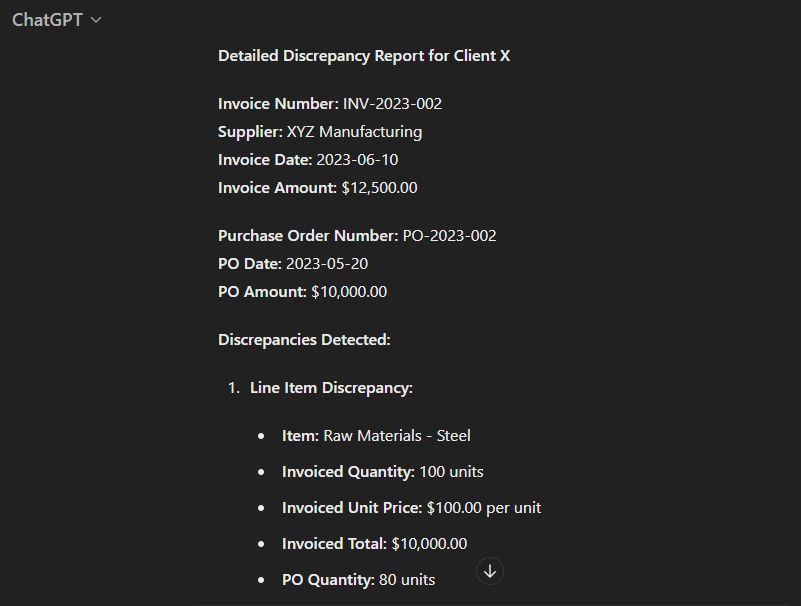
For instance, ChatGPT can quickly identify discrepancies between invoiced amounts and purchase orders. Simply provide the AI with the necessary data and context, and it delivers accurate results.
You might input a prompt like, “Can you help automate the process of checking discrepancies between invoiced amounts and purchase orders?” It will then generate a detailed response, saving you precious time and reducing error potential.
2) Enhance Client Experience
ChatGPT is also a valuable asset for improving client interactions. It ensures professional and consistent communication across your firm, which strengthens your brand image.
The AI provides rapid responses, a crucial advantage during busy seasons when clients expect timely updates. You can even use it to draft professional emails quickly.
Imagine needing to respond to members, partners, or vendors; ChatGPT can generate a draft in seconds. While it might require slight adjustments, it significantly accelerates your communication process and improves overall client satisfaction.
3) Support Training and Continuous Learning
Staying updated with new concepts, evolving regulations, and emerging technologies in the accounting industry can be challenging. Fortunately, ChatGPT offers robust support for continuous learning.
It provides clear explanations and examples to enhance comprehension of complex topics. You can explore hypothetical scenarios or case studies for analysis and interpretation.
Furthermore, ChatGPT offers insights into specialized areas like forensic accounting, tax planning strategies, or risk management techniques. This makes it an excellent resource for ongoing professional development.
Practical Ways Accounting Firms Can Utilize ChatGPT
1) Create Engaging Blog Posts
ChatGPT assists you in developing informative blog posts for your accounting firm. While you should not rely on it exclusively for full content creation, it’s excellent for brainstorming ideas, generating outlines, and conducting grammar and spelling checks.
It can also offer valuable SEO suggestions to boost your content’s visibility. Remember to use specific prompts to avoid generic results.
For example, you might instruct it: “Write in an authoritative yet informal, conversational tone, incorporating personal anecdotes when relevant. Focus on clear, concise business advice, addressing the reader directly to build connection. Present a problem first, then offer actionable solutions.”

When you ask ChatGPT to rewrite a draft with such a prompt, you get distinctive content. This tailored writing style resonates far better with your audience compared to generic, uninspired text.

2) Draft Client Emails Efficiently
Firm owners can use ChatGPT to craft personalized emails for clients quickly. Create a set of prompts that provide essential client information, like their first name, industry, the email’s purpose, and any specific concerns or calls to action.
A simple prompt might be: “Write a professional yet casual email reminder to a client about an upcoming quarterly tax return deadline. Remind them to submit necessary documentation soon, include a friendly closing, and sign off with my name.”
Within seconds, ChatGPT provides a fresh draft that you can review and edit as needed. This saves significant time, allowing you to maintain consistent communication with minimal effort.

3) Convert Loom Videos into SOPs
Loom videos are fantastic for quick explanations, but converting them into written Standard Operating Procedures (SOPs) can be time-consuming. ChatGPT offers a brilliant solution to streamline this process.
Simply copy and paste the transcript from your Loom video into ChatGPT. Then, ask the AI to summarize it into a clear, step-by-step SOP.
This method transforms visual instructions into easily digestible written documentation, making training and process replication much more efficient. It’s a simple yet powerful way to leverage existing content.
4) Transform PDF Files into Excel Data
Extracting data from PDFs and manually entering it into Excel is a notoriously time-consuming process. ChatGPT significantly streamlines this effort, especially with newer versions like GPT-4.
You can copy and paste data from your PDFs directly into ChatGPT and ask it to format the information into a table. This table will be ready for easy insertion into Excel, saving you hours of manual work.
Even better, GPT-4 now allows direct file uploads. This feature provides a more convenient and integrated experience, making data extraction from PDFs incredibly efficient.
5) Classify Uncategorized Bank Transactions
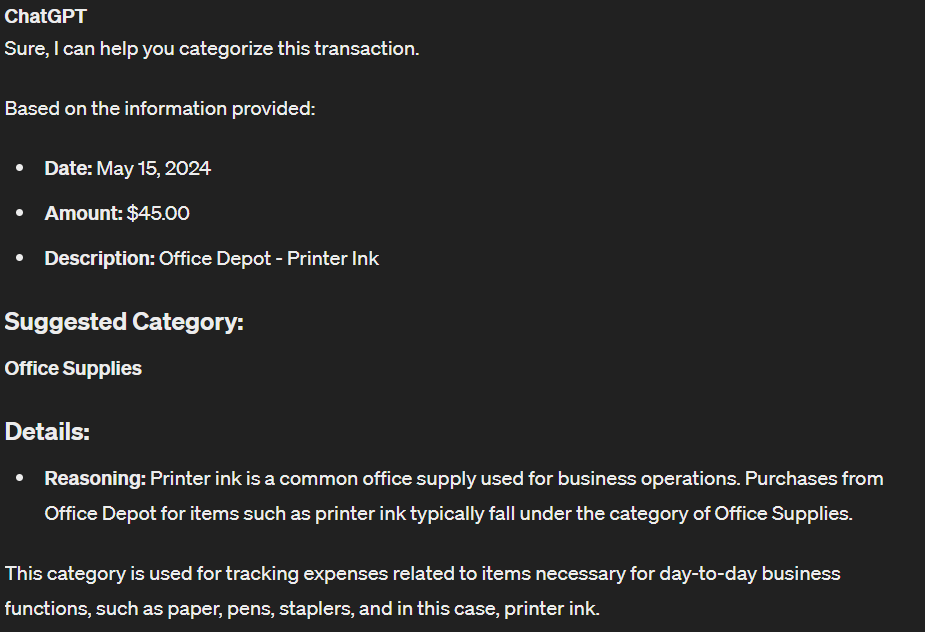
ChatGPT can dramatically speed up bookkeeping by reviewing transactions and suggesting appropriate categories. Simply input the raw transactions into the chatbox.
The AI will then provide categorization suggestions, which you can accept or adjust as needed before updating your records. This process saves considerable time and significantly enhances accuracy.
For example, if you input “Date: May 15 2024, Amount: $45.00, Description: Office Depot – Printer Ink,” ChatGPT will suggest a category like ‘Office Supplies’ or ‘Business Expenses’, making your workflow smoother.
6) Generate Engaging Social Media Posts
Building a strong online presence for your accounting firm requires a constant stream of fresh, engaging social media content. With billions of people on social media, establishing your presence is crucial.

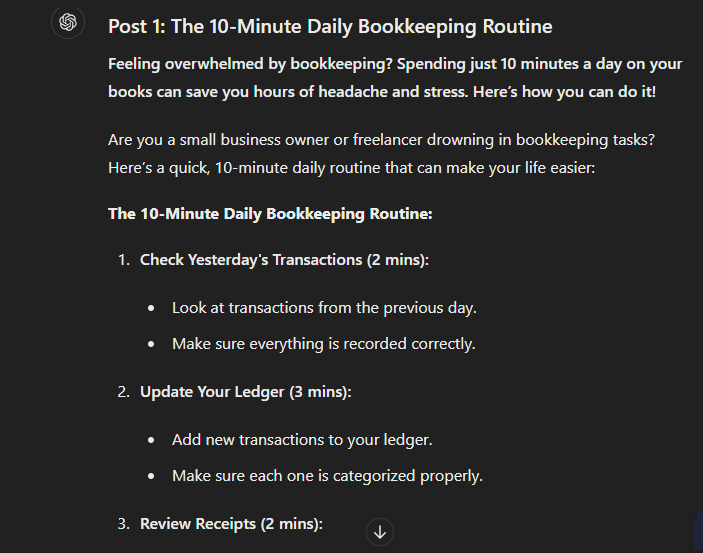
ChatGPT can create social media posts tailored to your target audience. You can specify the tone, keywords, and call to action, then tweak the output until it perfectly matches your brand voice.
While you’ll likely need to make minor edits, ChatGPT provides a strong foundation. This tool ensures your firm maintains an active and relevant social media presence with minimal effort.
7) Summarize Meeting Notes Quickly
ChatGPT excels at summarizing meeting notes, transforming lengthy discussions into concise, actionable insights. You can significantly reduce the time spent on post-meeting administration.
Start by recording your meeting using a tool with transcription capabilities, like Loom. If your tool doesn’t transcribe, use a dedicated transcription service to convert the audio into text.
Once you have the transcription, input it into ChatGPT with a prompt such as: “Summarize the following meeting notes, focusing on key decisions, action items, and important points discussed: [Paste transcribed text here].” This gives you a clear, distilled summary.

8) Resolve Excel Formula Issues
Have you ever forgotten a specific Excel formula or struggled with its correct input? ChatGPT can provide step-by-step instructions to resolve these common frustrations.
Simply describe the task or calculation you need to perform, and ChatGPT will generate the appropriate formula. This feature makes your financial reporting process faster and much easier.
For example, if you ask how to calculate compound interest in Excel, ChatGPT will give you the exact formula and how to use it. Consider exploring custom GPTs designed specifically for Excel assistance for even more advanced help.


9) Reduce Market Research Time
ChatGPT dramatically cuts down your market research time by summarizing reports and articles, answering specific questions from provided content, generating valuable insights from data, and recommending additional resources.
For instance, you can perform a thorough competitor analysis in just a few steps. First, gather competitor names, news articles, financial reports, and press releases.
Then, provide all this data to ChatGPT and instruct it to summarize. You can then ask specific questions, such as identifying key strategies or market positions, gaining quick and comprehensive insights.

If you subscribe to a paid ChatGPT plan, leverage its advanced deep research model, ChatGPT 4.5, for even more sophisticated analysis and data interpretation.

10) Design Email Signatures for Advertising
Your email signature is an underrated marketing tool for your accounting firm. It offers a subtle yet effective way to promote your services with every email you send.
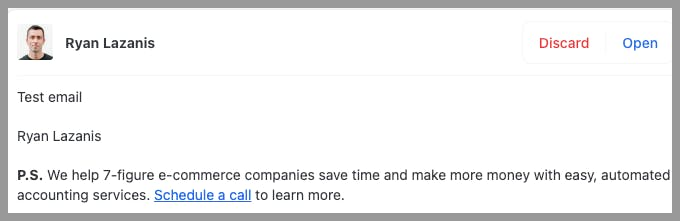
If you’re unsure what to include, ChatGPT can generate a list of creative ideas for your email signature. For example, you might ask, “Can you send me a list of possible email CTAs for an accounting firm targeting SaaS startups?”
ChatGPT will provide compelling options, allowing you to choose the most effective call to action. This small but impactful detail can drive new engagement for your firm.

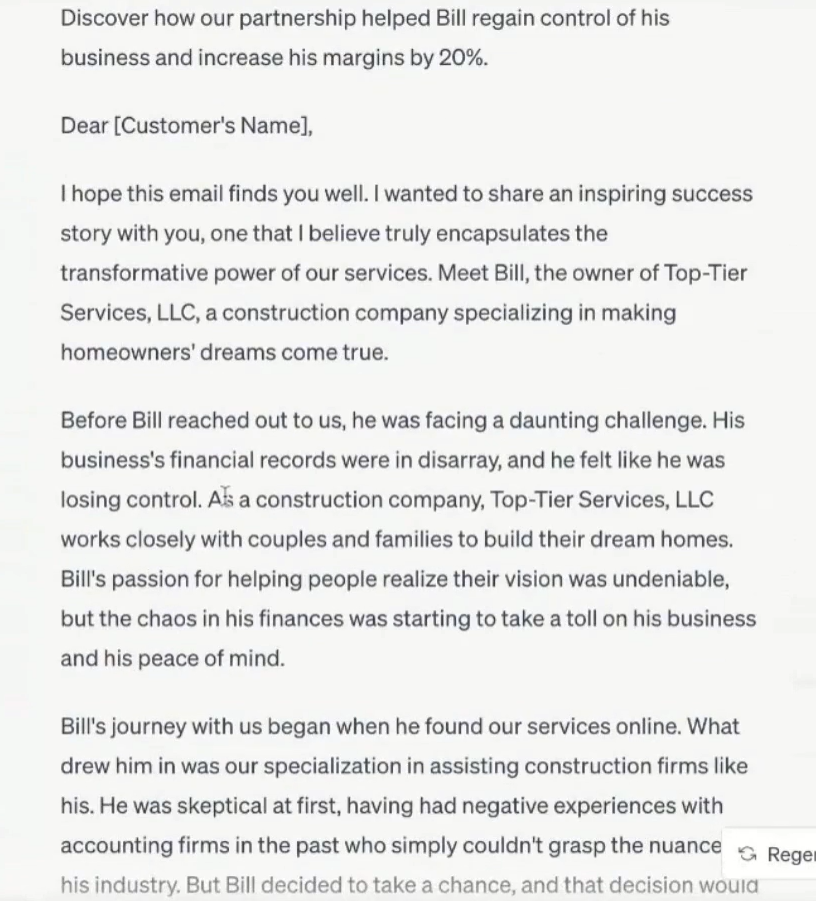
11) Craft Better Case Studies
Case studies are highly effective marketing tools because they provide intricate details about how your services directly benefit clients. They build trust and demonstrate tangible results.
You can use ChatGPT to help create compelling client case studies. Simply include specific details in your prompt about your clients, the challenges they faced, and how your firm successfully helped them overcome these obstacles.
ChatGPT will generate a detailed draft that’s almost ready to use. You can then fine-tune it to ensure it perfectly reflects your client’s success story and your firm’s expertise.
12) Summarize Information for Monthly Executive Summaries
How to use AI software for monthly close process effectively involves leveraging tools like ChatGPT for executive summaries. This streamlines reporting and ensures clarity and conciseness for stakeholders.
Before using ChatGPT, collect all relevant data and reports for your monthly executive summary. This includes financial statements, key financial metrics, budget vs. actual analysis, and notes on major financial events or transactions.
Prepare your input by clearly labeling each data section to provide context for ChatGPT. For example, specify ‘Revenue: Current Month: $X, Previous Month: $Y, Year-over-Year Change: Z%’.
Input your organized data and prompts into ChatGPT, ensuring you anonymize any sensitive information for privacy. Specify the desired tone and length, such as ‘concise and professional’.
Carefully review the summary ChatGPT generates for accuracy and completeness. Make any necessary adjustments to ensure it aligns perfectly with your expectations and the recipients’ needs, making your monthly close process smoother and more efficient.

13) Simplify Complex Tax Regulations
ChatGPT is an excellent resource for interpreting complex tax regulations and providing simplified summaries. This makes it significantly easier for accountants to understand and apply new rules.
You can use a sample prompt like, “Can you summarize Section 179 of the new tax regulations regarding small business deductions in a more digestible manner?” ChatGPT will break down the legal jargon into understandable language.
Beyond summaries, you can also use ChatGPT for computations. For instance, ask it to “Calculate the tax liability for a business with annual revenue: $500,000, deductible expenses: $200,000, depreciation expense: $30,000, tax credits: $10,000, and an applicable tax rate: 21%.”

Risks of Using ChatGPT in Accounting
While ChatGPT offers immense benefits, it’s essential to be aware of potential risks. Understanding these challenges helps you implement AI responsibly and effectively within your accounting firm.

AI Errors
One significant risk of using ChatGPT, like any AI, is the potential for errors due to a lack of human oversight. While AI processes vast amounts of data, it can still make mistakes that might go unnoticed without careful manual review.
Always double-check critical outputs, especially when dealing with financial figures or compliance-related information. Human verification remains crucial to ensure accuracy and prevent costly errors.
Generic Results
ChatGPT is a powerful machine learning tool, but without sufficient human input and specific prompts, it often produces generic content. Relying solely on AI for tasks like marketing can lead to bland, unoriginal material that fails to capture attention.
To avoid generic results, provide detailed instructions and refine your prompts. Remember, ChatGPT works best as an assistant, enhancing your work rather than fully automating every aspect without your unique touch.
Data Security Concerns
Security risks are inherent when using ChatGPT and other AI models, especially when handling sensitive financial data. Once confidential information enters a system, it raises concerns about privacy and data breaches.
Always exercise caution and avoid inputting highly sensitive or proprietary client data directly into public AI models. Explore secure, enterprise-level AI solutions or implement strict internal protocols to protect client information.
Frequently Asked Questions About ChatGPT in Accounting
Q: Can ChatGPT fully automate all accounting tasks?
A: No, ChatGPT cannot fully automate all accounting tasks. It excels at automating repetitive, data-heavy, and communication-focused tasks, but it still requires human oversight for critical analysis, decision-making, and ensuring accuracy and compliance.
Q: What are the main risks of using ChatGPT in accounting?
A: The main risks include AI generating errors without human oversight, producing generic or inaccurate content if prompts are not specific enough, and potential data security concerns when handling sensitive client information. Always verify outputs and protect data.
Q: How can accounting firms ensure accuracy when using ChatGPT?
A: Accounting firms should implement a rigorous review process for all AI-generated content and data. Always cross-reference ChatGPT’s outputs with original source documents and have a human expert verify critical information, especially for financial reports and client communications.
Q: Is ChatGPT safe for sensitive financial data?
A: Using public versions of ChatGPT for highly sensitive financial data carries security risks. For critical information, consider using enterprise-level AI solutions with robust data protection, anonymize data before input, or avoid inputting highly confidential client details directly into general AI models.
Q: How does ChatGPT help with the monthly close process?
A: ChatGPT can significantly assist the monthly close process by summarizing financial data, reports, and key metrics into concise executive summaries. It helps identify variances, draft commentary, and streamline reporting, making the process faster and more efficient while ensuring clarity for stakeholders.
Keywords: ChatGPT, AI in accounting, accounting automation, financial technology, monthly close process, tax simplification, client communication, SOP creation, market research, Excel formulas, business efficiency, finance AI