Unlocking Efficiency: Your Guide to Generative AI in Accounting
Generative AI tools like ChatGPT are quickly reshaping how businesses operate, and accounting is no exception. With hundreds of millions of users, these platforms offer powerful capabilities to boost productivity in various financial tasks. You can leverage AI for everything from brainstorming and research to in-depth financial analysis and streamlined communications.
This article explores practical ways you can integrate generative AI into your accounting workflows. We’ll dive into specific applications that enhance efficiency and accuracy, all while maintaining crucial human oversight. Get ready to transform your accounting processes with smart AI assistance.
What is Generative AI (ChatGPT)?
ChatGPT stands as a prominent example of generative AI, specifically a large language model (LLM) developed by OpenAI. It uses natural language processing (NLP) to understand and generate human-like text, images, audio, and other outputs. Essentially, you engage with it through conversational prompts or questions, and it delivers relevant, AI-generated responses.
This sophisticated technology employs a multi-layered deep learning neural network, a subset of machine learning, to process vast amounts of data. Many software applications now integrate ChatGPT’s functionality via API, embedding its power directly into their platforms. This integration allows for seamless automation and intelligent assistance across various business functions.
Navigating Generative AI’s Current Limitations
While incredibly powerful, generative AI tools like ChatGPT are not flawless and require mindful usage. Their effectiveness largely depends on the quality of your input and your ‘prompt engineering’ skills. Human judgment, fact-checking, and iterative refinement of outputs remain essential to ensure accuracy and relevance.
Furthermore, privacy and security are significant concerns; you should never input sensitive or confidential information directly into these public AI models. ChatGPT’s training data has a specific cut-off date (e.g., September/November 2023 for GPT-4 models), so it might not possess the most current information. While ‘search’ and ‘research’ modes can access more recent web data, always verify critical financial or legislative information independently.
12 Smart Ways Generative AI Boosts Accounting Efficiency
Accountants can effectively integrate generative AI into many daily tasks, significantly enhancing productivity. Here are a dozen practical applications to consider for your accounting practice or business finance department:
1. Streamline Invoice Processing
Generative AI can assist in various aspects of invoice processing, particularly with initial expense coding. While standalone AI tools offer some help, specialized AP automation software with embedded AI features provides superior accuracy and efficiency. These integrated solutions enhance account coding predictions and improve purchase order matching for a smoother workflow.
2. Optimize Expense Coding
Accurately assigning expenses to the correct general ledger accounts is crucial for financial reporting. You can use AI to help categorize transactions, improving the speed and consistency of this process. Understanding how to use generative AI for journal entries can particularly streamline your daily recording, ensuring consistency and compliance.
3. Enhance Data Cleansing
Maintaining clean and accurate accounting data is vital for reliable reporting and successful system migrations. Generative AI can assist in cleaning data by identifying and removing unnecessary characters, correcting inconsistencies, and eliminating duplicate entries in spreadsheets or customer master files. This ensures your data foundation is solid before any significant system changes.
4. Customize Output Formatting
If your existing accounting software’s report formats don’t meet your specific needs, generative AI can help. You can provide AI with your financial statements or reports as input and prompt it to reformat them. This includes restructuring tables, generating CSV files for imports, or even sorting data according to your preferences.
5. Generate Report Narratives and Notes
AI can significantly aid in preparing compelling narratives and explanatory notes for financial reports and statements. It can analyze significant changes in account balances, revenues, expenses, and profitability across comparative periods, offering insights. For internal reports, AI can even suggest actionable improvements for profitability.
When preparing formal Notes to Financial Statements, always fact-check AI-generated content against the latest GAAP or IFRS standards. For public company CFOs, AI can help analyze financial results and draft conference call scripts, even anticipating questions from financial analysts.
6. Create Computer Code
Need custom scripts or formulas? Generative AI can generate computer code in various languages like JavaScript, Python, R, or Excel macro code and formulas. If the code isn’t working as expected, simply provide the problem description, and AI can help revise it. This capability empowers accountants to automate specific tasks without extensive programming knowledge.
7. Analyze Data for Decision-Making
AI excels at analyzing financial data to detect anomalies, trends, or unusual percentage changes that warrant further investigation. This insightful information is invaluable for strategic decision-making. For instance, an AI-driven financial analysis might uncover operational inefficiencies, leading to cost reductions and improved business profitability.
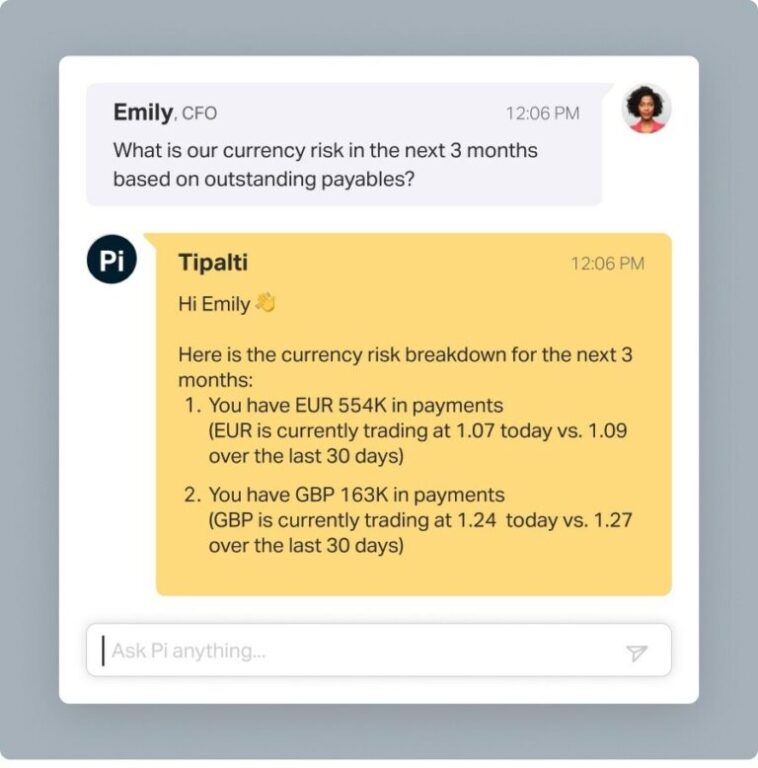
Some integrated accounting platforms now feature AI-powered digital assistants that provide real-time financial data insights and spend analysis. These tools offer instant access to critical business information, saving time and resources for crucial decisions.
8. Research for Business Plans and Pitch Decks
Developing a comprehensive business plan or pitch deck requires extensive research. Generative AI can perform preliminary research, helping you gather information and brainstorm ideas. Remember to fact-check all AI-generated content and provide up-to-date inputs for the most accurate results, especially when using ‘Search’ or ‘Deep Research’ features.
9. Develop Preliminary Financial Forecasts and Budgets
AI can assist in creating initial demand predictions, financial forecasts, and budgets. While not yet accurate enough for independent finalization, these AI-generated drafts provide a solid starting point. You can then apply your expert judgment and additional data to refine and improve these preliminary financial projections.
10. Support Audit Processes
External audits often involve analytical reviews to identify anomalies in financial data. Generative AI serves as an excellent aid in this process, helping auditors analyze large datasets more efficiently. As audit automation programs increasingly incorporate AI, its role in streamlining audit procedures for public accounting firms will grow.
11. Research Tax and Legislation Compliance
While AI cannot prepare accurate tax returns on its own, it proves highly effective for tax research. You can use it to summarize new tax laws or other government legislation, providing quick overviews. For the latest information, leverage AI’s ‘Search’ feature or input relevant PDF documents containing legislative content, provided they meet file size limits.
12. Enhance Business Communications and Brainstorming
Generative AI is a powerful tool for brainstorming ideas and drafting various business communications, including emails and reports. By providing prompts detailing your desired writing style, context, and tone, AI can generate tailored content. Always review and revise AI suggestions for accuracy and clarity, ensuring they align perfectly with your message.
Beyond Basic Prompts: Evolving Generative AI Features
OpenAI consistently introduces new features that expand ChatGPT’s capabilities beyond simple text generation. Recent advancements include multimodal interactions, allowing both text and image inputs, significantly broadening its utility. Users can now upload files, integrating external documents directly into their AI conversations for richer context.
The addition of a Code Interpreter empowers ChatGPT to perform data analysis and execute code within the chat interface. More recent features like Voice and Image Interaction, DALL·E 3 integration for image generation, and the GPT-4o (‘Omni’) model offer enhanced real-time processing of various media. Furthermore, the introduction of ‘Search’ capabilities allows ChatGPT to access current internet information, providing more up-to-date insights beyond its initial training data cut-off.
The Future of AI in Accounting: A Collaborative Approach
AI accounting is no longer a distant concept; it’s an integral part of the present and future of digital transformation for the profession. The impact of generative AI, including ChatGPT, on accounting is immense and continues to grow. Expect to see AI models integrated as embedded features in an increasing number of software programs, unlocking new and reliable use cases.
Major players like Intuit are already partnering with OpenAI to integrate advanced AI models into their software products. This collaboration aims to build secure, intelligent, and personalized AI-powered experiences across their platforms, from tax preparation to financial management. As AI continues to evolve, it will empower finance professionals, streamlining workflows and allowing them to focus on strategic insights rather than repetitive tasks.
Frequently Asked Questions About Generative AI in Accounting
Can generative AI automate all accounting tasks?
While generative AI can significantly assist with many accounting tasks, such as invoice coding and drafting report narratives, it cannot fully automate all processes. Comprehensive automation, especially for critical functions like accounts payable, often requires specialized accounting software with embedded AI tools. These integrated solutions ensure accuracy, compliance, and scalability that standalone AI might not yet offer.
Is human oversight still necessary when using generative AI for accounting?
Absolutely. Human judgment, fact-checking, and iterative refinement remain crucial when utilizing generative AI in accounting. AI tools are powerful assistants, but they require human expertise to ensure the accuracy, ethical considerations, and strategic alignment of their outputs. Accountants will continue to play a vital role in validating information and making informed decisions.
What are the primary benefits of using generative AI in accounting?
Generative AI offers numerous benefits, including increased efficiency through task automation, improved data analysis for better decision-making, enhanced accuracy in coding and reporting, and streamlined communication. It frees up accountants from repetitive tasks, allowing them to focus on higher-value activities like strategic planning and financial analysis.
Keywords: generative AI accounting, ChatGPT accounting, AI for finance, accounting automation, journal entries AI, financial data analysis, AI in bookkeeping, accounting technology, financial forecasting AI, business communication AI