Artificial intelligence, particularly large language models like ChatGPT, is revolutionizing various industries, and accounting is no exception. With hundreds of millions of users, generative AI tools are becoming indispensable for businesses aiming to boost productivity and streamline operations.
Accountants can leverage AI for diverse tasks, from automating routine work to gaining deeper financial insights. This includes brainstorming, conducting research, analyzing data, and enhancing business communications, all while maintaining crucial human oversight.
Understanding ChatGPT and Its Role in Accounting
ChatGPT, developed by OpenAI, is a generative AI model using natural language processing (NLP). It functions as a chatbot, answering user queries and generating human-like text, images, or audio based on prompts and attached files.
This powerful tool taps into vast datasets, performs internet searches, summarizes documents, and assists with various AI-driven tasks. Its applications in accounting and bookkeeping help businesses reduce manual effort, analyze trends, and spot data anomalies.
Current Limitations to Consider
While incredibly versatile, ChatGPT’s effectiveness largely depends on the quality of your prompts. It’s not yet perfect, often requiring human review, fact-checking, and refinement of its outputs.
Always exercise caution and avoid inputting sensitive information, as OpenAI advises against it due to privacy and security concerns. Additionally, the model’s knowledge cutoff means you may need to utilize its ‘search’ or ‘deep research’ modes for the most up-to-date information.
12 Smart Ways to Use AI in Your Accounting Workflow
Integrating ChatGPT into accounting practices can significantly enhance efficiency and accuracy. Here are 12 practical applications that can transform how accountants work:
1. Invoice Processing
You can use an AI assistant for invoice processing to streamline various aspects, such as coding expenses. While a standalone AI might assist, dedicated AP automation software with embedded AI features offers superior efficiency and accuracy.
Solutions like Tipalti’s AP automation, which incorporates ChatGPT, enhance account coding predictions and improve purchase order matching. This creates a powerful end-to-end system for automated invoice processing, including global payments.
2. Coding Expenses
While you can attempt to code accounting expenses using ChatGPT alone, integrating it with specialized AP automation software delivers far better results. Tools with built-in AI ensure accurate coding of supplier invoices to the correct accounts.
This digital transformation eliminates manual data entry and paper documents, reducing errors by up to 66%. It also strengthens financial controls and significantly cuts down the time spent on payables processes.
3. Data Cleansing
ChatGPT proves invaluable for cleaning accounting data. It can remove unnecessary characters from customer names, eliminate duplicate entries in spreadsheets, or refine your customer master file.
Ensuring clean data is a critical step, especially before migrating information to a new software system, preventing potential issues down the line.
4. Formatting Output
If your current accounting software or ERP system’s financial statement formats don’t meet your needs, ChatGPT can help. You can input files and prompts to reformat financial statements, reports, tables, or even generate CSV files for imports.
Although powerful, remember that ChatGPT isn’t designed to produce full financial statements from raw transactions alone; your core accounting system handles that crucial function.
5. Report Narratives and Notes
Enhance financial reports and statements with detailed narratives, notes, and even visualizations using ChatGPT. It can analyze significant changes in account balances or profitability across comparative periods.
For internal reports, AI can suggest ways to improve profitability. When preparing formal Notes to Financial Statements, always fact-check and supplement AI-generated content with the latest GAAP or IFRS standards.
6. Generating Computer Code
ChatGPT can generate computer code in various languages like JavaScript, Python, R, or Excel macro code and formulas. If you encounter issues, you can ask it to revise the code based on error descriptions.
Simply copy the generated code into your application and follow any additional steps to achieve your desired outcome.
7. Data Analysis for Decision-Making
Utilize ChatGPT to analyze financial and accounting data, helping you detect anomalies in trends, amounts, or percentage changes that warrant further investigation. This insightful information is crucial for informed decision-making.
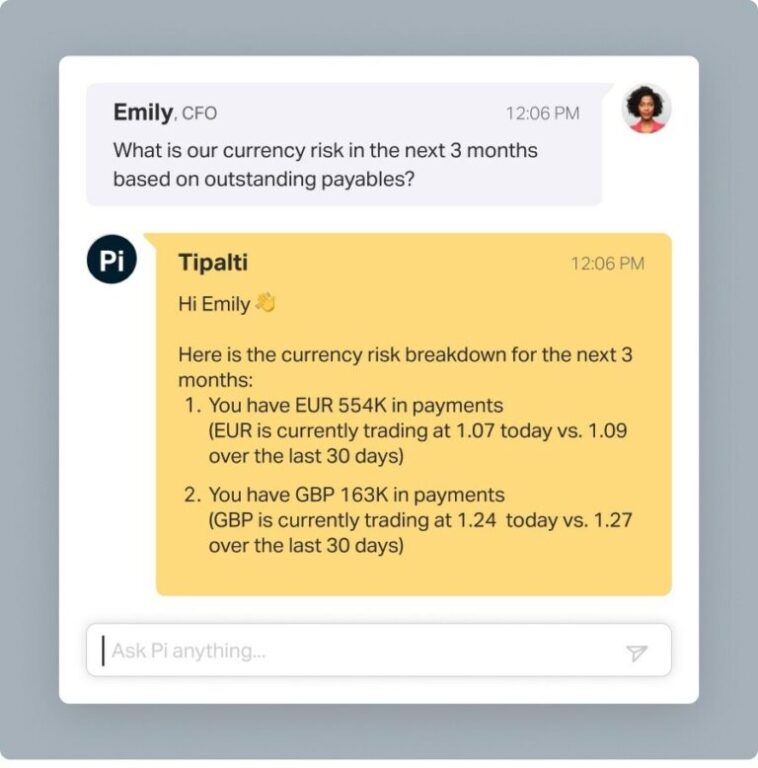
For instance, an AI-driven financial analysis might highlight operational improvements that could lead to cost reductions and boosted business profitability. Tipalti’s digital assistant, Ask Tipalti AI SM, offers real-time financial insights and spend analysis.
8. Business Plan and Pitch Deck Research
Preparing a business plan or pitch deck demands extensive research, and ChatGPT can provide a strong starting point. Use it for preliminary research, but always fact-check and provide up-to-date information through specific prompts or its ‘Search’ feature.
While ChatGPT can’t create PowerPoint presentations directly, it’s excellent for brainstorming ideas and generating text or images for your content.
9. Preliminary Financial Forecasts and Budgets
AI can assist in creating preliminary demand predictions, financial forecasts, and budgets. However, these initial outputs aren’t accurate enough for final decisions on their own.
Always apply your expert judgment and integrate additional information to refine and improve these early financial projections.
10. Audits
In external audits, analytical reviews are essential for identifying anomalies in financial data. ChatGPT can serve as an auditing aid by helping analyze this data, potentially simplifying the process for CPA firms.
Furthermore, businesses under audit can use ChatGPT to prepare general ledger account reconciliation schedules, which can help reduce audit fees.
11. Tax and Legislation Compliance Research
While not yet equipped to prepare accurate tax returns, ChatGPT excels at tax research. It can summarize new or existing legislation, like tax laws or government regulations.
For this, you might use ChatGPT’s ‘Search’ feature for internet searches or attach PDF documents containing the legislation’s content.
12. Business Communications and Brainstorming
From brainstorming new ideas to drafting emails, reports, and other business communications, ChatGPT is a powerful assistant. Provide specific prompts about your desired writing style, context, and tone.
Always review and revise the AI-generated content for accuracy and clarity. You can also use other AI editing tools, like GrammarlyGO, to further refine your communications.
The Future of AI in Accounting
AI accounting is not just a future trend; it’s a present reality driving digital transformation in the profession. As AI models like ChatGPT become more sophisticated, they will integrate seamlessly into more software programs, uncovering new and reliable use cases.
Companies like Intuit are already partnering with OpenAI to embed advanced AI capabilities into their financial products. This evolution promises to make tasks like preparing financial statements and tax returns even more automated and efficient, positioning AI as finance’s greatest asset.
Frequently Asked Questions (FAQs)
Can ChatGPT fully automate my accounting department?
While ChatGPT significantly assists with tasks like invoice coding and report generation, full automation requires integrated AI tools within specialized accounting software. These tools ensure accuracy, compliance, and scalability beyond what a standalone ChatGPT can offer.
Is it safe to input sensitive financial data into ChatGPT?
No, it is not recommended to input sensitive financial information directly into ChatGPT. OpenAI advises against it due to potential privacy and security risks. Always prioritize data confidentiality and use secure, dedicated financial software for sensitive data.
How can I ensure the accuracy of ChatGPT’s financial outputs?
Always treat ChatGPT’s outputs as preliminary and requiring human verification. Fact-check all information, cross-reference with reliable sources, and apply your professional judgment. Refining your prompts and providing specific context can also improve accuracy.
What is the most effective way to use AI assistant for invoice processing?
The most effective way involves integrating an AI assistant, like ChatGPT’s features, into a robust accounts payable (AP) automation system. This combination allows for intelligent invoice capture, automated data extraction, smart coding predictions, and efficient approval workflows, drastically reducing manual effort and errors.
Keywords: AI in accounting, ChatGPT for finance, invoice processing AI, accounting automation, financial AI tools, data cleansing, report generation AI, financial forecasting, audit automation, tax research AI