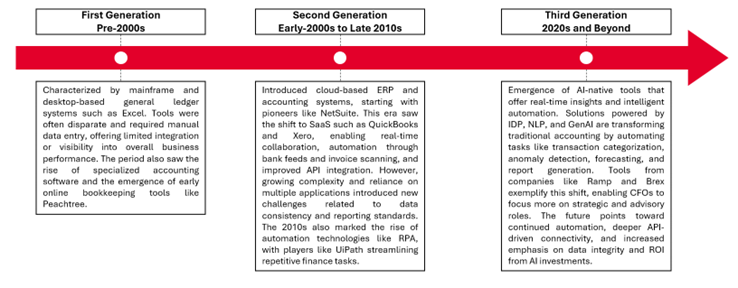
The world of accounting has come a long way since Luca Pacioli codified double-entry bookkeeping in 1494. For centuries, his foundational framework provided merchants with a structured view of their businesses. Today, we stand at a similar crossroads, but this time, artificial intelligence (AI) is the catalyst for change.
AI isn’t just automating tasks; it’s fundamentally redefining the entire discipline of financial reporting. Are you curious about how cutting-edge technology is reshaping the world of finance? This beginner’s guide to machine learning tools for financial reporting will walk you through the exciting changes.
Historically, accounting subspecialties like bookkeeping, payroll, tax, and audit were incredibly labor-intensive. These processes relied heavily on manual work, making them prime candidates for automation. Now, AI technologies are stepping in to deliver both accuracy and efficiency, revolutionizing these traditional methods.
New tools such as Generative AI (GenAI), Optical Character Recognition (OCR), Intelligent Document Processing (IDP), and smart agents are taking over repetitive duties. They handle tasks like data extraction, reconciliation, and invoice processing, significantly reducing errors. This frees up financial professionals to concentrate on higher-value analysis and critical judgment.
Beyond Automation: Strategic Insights
The real power of AI in financial reporting extends far beyond simple automation. Predictive analytics, for instance, dramatically sharpen financial forecasts, offering a clearer view of future performance. AI-powered audit tools can scrutinize entire datasets in mere seconds, identifying potential issues with unprecedented speed.
Anomaly detection systems proactively flag risks before they escalate, preventing costly problems. These combined capabilities enable the long-sought goal of ‘continuous closing.’ This means financial data updates, validates, and analyzes in real time, eliminating the traditional weeks-long period-end reconciliation process. Organizations gain a live, accurate view of performance, transforming accounting from a backward-looking process into a dynamic, forward-looking intelligence system.
Understanding Key Machine Learning Tools for Financial Reporting
For those new to the field, navigating the various machine learning tools for financial reporting can seem daunting. Let’s break down some of the most impactful technologies that are reshaping how finance teams operate, providing a solid beginner’s guide to machine learning tools for financial reporting.
Intelligent Document Processing (IDP): This technology combines AI, OCR, and Natural Language Processing (NLP) to read, extract, and validate data from various documents. Think invoices, receipts, and contracts – IDP drastically cuts manual data entry, boosting the accuracy of tax and transaction records.
Chatbots & AI Agents: These tools manage common queries, streamline workflows, and generate essential reports. They can handle vendor questions, guide staff through complex tasks, and significantly simplify financial research processes.
Generative AI (GenAI): GenAI can produce detailed reports, insightful analyses, and contextual information from vast datasets. It powers smarter accounts payable/receivable processes and enables faster, more compliant reporting.
Machine Learning (ML): As a cornerstone of AI, machine learning predicts trends, detects anomalies, and automates reconciliations. It’s crucial for improving forecasting, identifying potential fraud, and optimizing costs across the board.
Robotic Process Automation (RPA): RPA executes repetitive, rule-based workflows, such as payroll processing or standard reconciliations. When combined with AI, RPA enhances accuracy and allows for more adaptive decision-making.
Natural Language Processing (NLP) & Optical Character Recognition (OCR): These technologies convert unstructured text and documents into structured, usable data. They can extract critical clauses, summarize lengthy reports, and dramatically improve financial analytics.
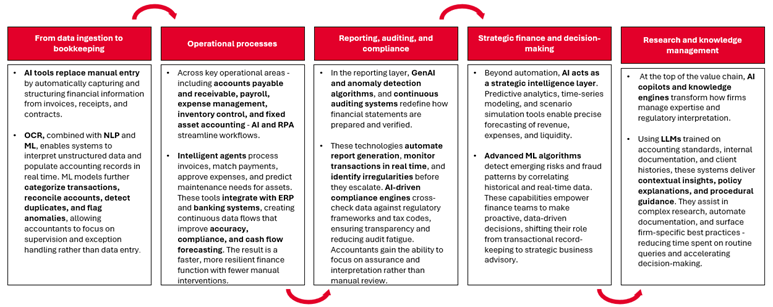
Together, these technologies are transforming accounting from a manual, retrospective process into an intelligent engine for business insight. They collectively reshape the entire accounting value chain, delivering real-time financial understanding.
The Shift in Accountant’s Role
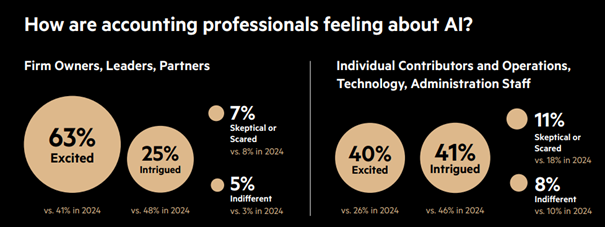
As automation takes over transactional work, the role of accountants fundamentally shifts. Finance professionals are moving away from execution towards strategic advisory and decision enablement. Instead of manual reconciliations or data entry, they now focus on identifying and analyzing anomalies, interpreting insights, and advising business leaders.
AI copilots and intelligent assistants augment human expertise, suggesting optimizations and highlighting critical insights. This transformation elevates the finance function from a mere back-office operation to a central intelligence hub. Accountants are becoming data interpreters, storytellers, and risk managers, blending financial accuracy with crucial business foresight.
Navigating the Market: AI Product Strategies
The product strategies driving AI adoption in accounting are generally following two distinct paths. These involve either creating specialized AI agents and tools or developing comprehensive, full-stack AI platforms.
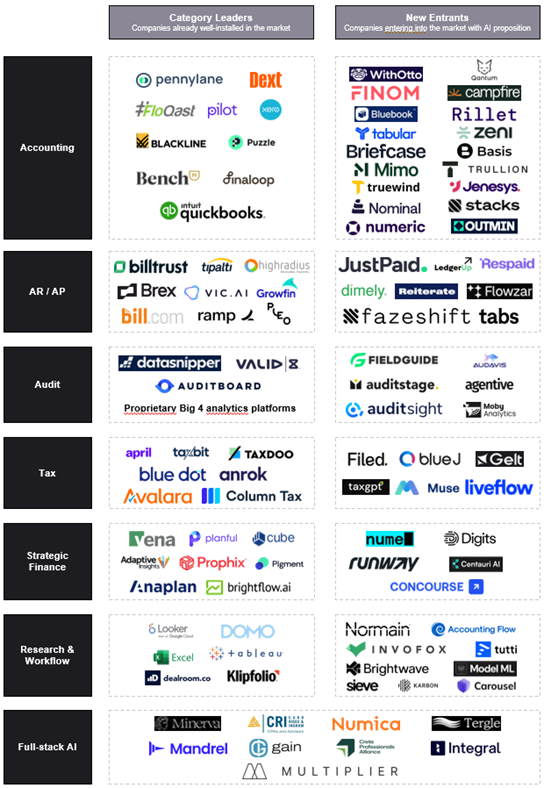
AI Agents and Tools (B2B SaaS): This model aligns with traditional enterprise software, where vendors license systems for specific tasks. These tasks include reconciliation, invoicing, tax filings, or anomaly detection, sold as B2B SaaS products. This subscription-based approach is appealing to established firms, enhancing productivity without disrupting existing client relationships.
Full-Stack AI Platforms: In contrast, full-stack AI companies aim to become the accountants themselves. They offer end-to-end services like bookkeeping, payroll, and tax compliance directly to small and medium-sized enterprises (SMEs) and individuals. These firms promise faster, cheaper delivery and higher margins by encoding labor into software, aiming to displace traditional incumbents.
Ultimately, both models will likely coexist. Established firms will adopt agents to protect their margins, while new challengers pursue full-stack strategies to gain market share. Accountants themselves must evolve into data scientists, validating AI outputs and translating insights into actionable business decisions.
Key Challenges and Risks
While AI promises immense benefits, its implementation in accounting presents significant challenges. Understanding these risks is crucial for successful adoption and maintaining trust in financial reporting.
Reliability and Accuracy: Generative AI systems can still produce ‘hallucinations,’ exhibit model bias, or present factual inconsistencies. In an industry with zero tolerance for errors, these issues are simply unacceptable. The rise of deepfakes also introduces reputational risks, as malicious actors could exploit AI for financial fraud.
Accountability and Context: A fundamental question arises: who is responsible when an AI tool makes an error? Current regulations typically place the burden on licensed professionals. Furthermore, many AI initiatives falter due to a lack of contextual understanding, often processing only summary data. True accounting judgment requires understanding why a change was made or how a discrepancy was resolved, not just the final figures.
Business Model Mismatch: Traditional accounting relies on a billable-hours model, which incentivizes maximizing utilization. AI, by dramatically reducing the time for routine tasks, can cannibalize revenue in these departments. The scalable, volume-driven SaaS model often clashes with legacy revenue structures, potentially creating resistance within firms.
Regulatory Hurdles and Scalability: The accounting industry operates under stringent and often fragmented regulatory regimes. The United States benefits from a unified framework (US GAAP, SEC, PCAOB), allowing providers to scale nationally with ease. Europe, however, faces a patchwork of local GAAPs, licensing regimes, tax codes, and reporting rules across 27 member states. This divergence makes achieving pan-European scale far more complex for AI solutions, requiring country-specific customization.
Conclusion
The future of financial reporting is undeniably intertwined with AI and machine learning. These technologies are not just tools for automation; they are catalysts for a profound transformation, turning accounting into a real-time, forward-looking intelligence system. While challenges around reliability, regulation, and business models exist, the benefits of enhanced accuracy, efficiency, and strategic insight are too significant to ignore. The firms and professionals who successfully integrate AI with human judgment will ultimately lead the way in this new era of finance.
FAQ Section
Q1: What is continuous closing in financial reporting?
A: Continuous closing is an accounting model where financial data is captured, reconciled, and validated constantly, rather than only at month-end or quarter-end. This approach uses AI and automation to provide real-time visibility into a company’s financial performance and compliance.
Q2: How does machine learning help detect fraud in finance?
A: Machine learning algorithms analyze vast amounts of transactional data to identify patterns and anomalies that might indicate fraudulent activity. They can flag unusual transactions, sudden changes in spending, or other deviations from normal behavior, alerting financial professionals to potential fraud faster than manual methods.
Q3: Will AI replace accountants entirely?
A: Most experts believe AI will transform, rather than eliminate, accounting jobs. AI automates repetitive and data-intensive tasks, allowing accountants to focus on higher-value activities such as strategic analysis, interpretation of data, advisory roles, and complex problem-solving. Accountants will evolve into data interpreters and strategic partners.
Q4: What’s the difference between AI agents and full-stack AI platforms in accounting?
A: AI agents and tools are specialized software licensed to firms for specific tasks like reconciliation or tax filing, enhancing existing workflows. Full-stack AI platforms, conversely, aim to provide comprehensive, end-to-end accounting services directly to businesses, effectively becoming the accounting service provider itself.
Q5: Why is regulatory compliance a challenge for AI in European accounting?
A: Europe has a highly fragmented regulatory landscape, with each of its 27 member states having distinct local accounting standards, tax codes, and reporting rules. This contrasts sharply with the more unified US system. AI solutions often require significant country-specific customization to meet these diverse compliance requirements, making pan-European scalability difficult.
Keywords: machine learning financial reporting, AI in accounting, financial technology, continuous closing, predictive analytics finance, intelligent document processing, generative AI finance, RPA in accounting, future of accounting, fintech tools