The Future of AI in Accounting: Transforming a Timeless Profession
For centuries, Luca Pacioli’s double-entry bookkeeping system provided the bedrock for businesses to track finances. Now, accounting stands at another monumental crossroads. Artificial intelligence isn’t just automating tasks; it’s fundamentally redefining the profession itself. This shift promises to reshape how finance teams operate, offering unprecedented accuracy and efficiency.
Many accounting specialities, from payroll and tax to audit and advisory, traditionally demand extensive manual effort. This makes them prime candidates for automation. AI, through technologies like Generative AI (GenAI), Optical Character Recognition (OCR), Intelligent Document Processing (IDP), and smart agents, now handles repetitive work such as data extraction, reconciliation, and invoice processing. This significantly reduces errors and frees professionals to focus on more complex analysis and strategic judgment.
Beyond Automation: Real-time Insights and Continuous Closing
The true power of AI extends far beyond simple automation. Predictive analytics can sharpen financial forecasts, while AI-powered audit tools can scrutinize entire datasets in mere seconds. Anomaly detection systems are crucial for flagging potential risks before they escalate into major problems.
These capabilities collectively enable the long-sought goal of “continuous closing.” This means financial data updates, validates, and analyzes in real time. Organizations no longer wait weeks for period-end reconciliations; instead, they maintain a live, constantly accurate view of their performance. Accounting evolves from a backward-looking function into a dynamic, forward-looking intelligence system.
The Evolving Accounting Market and AI’s Impact
Accounting remains the backbone of any business, converting financial complexities into clarity, compliance, and confident decision-making. The profession, traditionally built around a billable-hours model, employs millions of professionals across the US and Europe. For instance, the US alone boasts over 1.4 million accountants and auditors, with a market revenue exceeding $145 billion in 2025.
Educational pathways are also adapting. Requirements for CPA licensing, like KPMG’s historical 150-credit-hour model, are under review as fewer graduates enter the field and new skills in AI and ESG become essential. As technology matures, accounting firms are set for significant transformation driven by intelligent automation and data innovation.
Major players are already investing heavily. PwC has committed $1 billion to scale AI capabilities across its audit and tax services, and Thomson Reuters acquired Materia, an agentic AI specialist for the tax, audit, and accounting sectors. However, this isn’t a “robots taking our jobs” scenario. The World Economic Forum forecasts that AI and automation will create 58 million new jobs, primarily in high-skill areas.
Historical precedents, such as the rise of bookkeeping software in the 1980s, confirm that new technologies transform, rather than eliminate, roles. Despite initial fears, tools like Intuit and Excel contributed to a 75% growth in accounting roles over a decade, empowering professionals to take on more complex tasks. From early bookkeeping software to today’s cloud platforms, accounting has consistently embraced technological advancements.
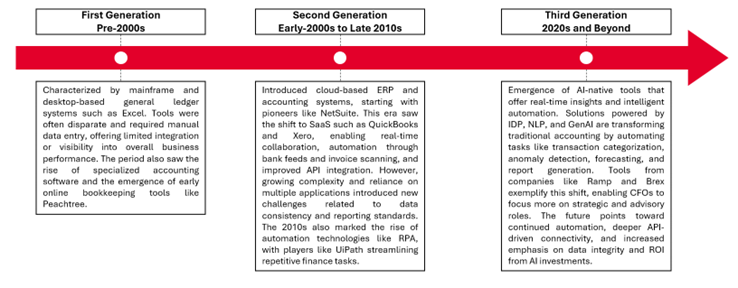
AI’s Transformative Role Across the Accounting Value Chain
AI is rapidly transforming every aspect of accounting, from end-to-end. It automates routine work, boosts accuracy, and unlocks real-time financial insights. These technologies are fundamentally reshaping how finance teams operate:
- Intelligent Document Processing (IDP): This combines AI, OCR, and Natural Language Processing (NLP) to read, extract, and validate data from various documents like invoices and contracts. It drastically cuts manual entry and enhances accuracy for tax and transactions.
- Chatbots & AI Agents: These tools manage queries, coordinate workflows, and generate reports. They can handle vendor questions, guide staff through intricate tasks, and streamline financial research.
- Generative AI (GenAI): GenAI produces detailed reports, analyses, and contextual insights from vast datasets. It powers smarter accounts payable/receivable processes and ensures faster, compliant reporting.
- Machine Learning (ML): ML predicts trends, identifies anomalies, and automates reconciliations. This leads to better forecasting, robust fraud detection, and optimized cost management.
- Robotic Process Automation (RPA): RPA executes repetitive workflows, such as payroll or routine reconciliations. AI further enhances RPA by improving accuracy and enabling adaptive decision-making.
- Natural Language Processing (NLP) & Optical Character Recognition (OCR): These convert unstructured text and documents into structured data. They can extract critical clauses, summarize reports, and significantly improve analytics capabilities.
These technologies collectively transform accounting from a manual, retrospective process into an intelligent, forward-looking engine for business insight.
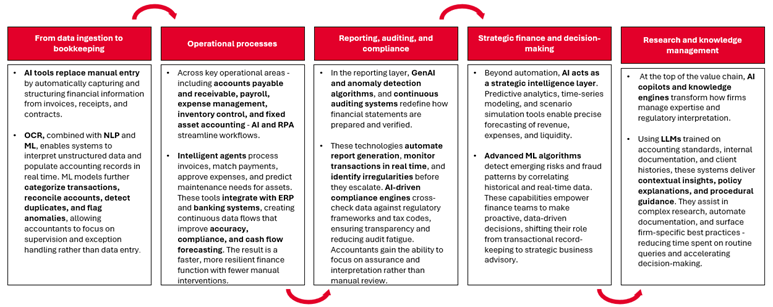
The Rise of Continuous Closing and Strategic Advisory
A key outcome of AI’s integration is the emergence of continuous closing. In this model, financial data is continuously captured, reconciled, and validated, rather than only at month-end. By embedding automation and intelligence into daily workflows, accounting teams maintain always-up-to-date books, providing real-time visibility into performance, liquidity, and compliance.
This evolution eliminates the traditional “period-end crunch.” Machine learning and RPA automatically reconcile transactions, GenAI generates contextual reports on demand, and anomaly detection tools ensure integrity across systems. The finance function now operates continuously, delivering instant insights to support decision-making and strengthening governance.
Moreover, as automation handles transactional work, the accountant’s role shifts dramatically. They move from execution to strategic advisory and decision enablement. Instead of manual reconciliations or data entry, finance professionals now focus on identifying and analyzing anomalies, interpreting insights, advising business leaders, and driving growth initiatives.
AI copilots and intelligent assistants augment human expertise, suggesting optimizations, highlighting anomalies, and surfacing critical insights for strategic choices. This transformation elevates finance from a back-office function to a central intelligence hub supporting corporate strategy in real time. Accountants become vital data interpreters, storytellers, and risk managers, bridging financial accuracy with business foresight. Ultimately, firms that combine automation with human judgment will thrive, leveraging AI to amplify financial expertise rather than replace it.
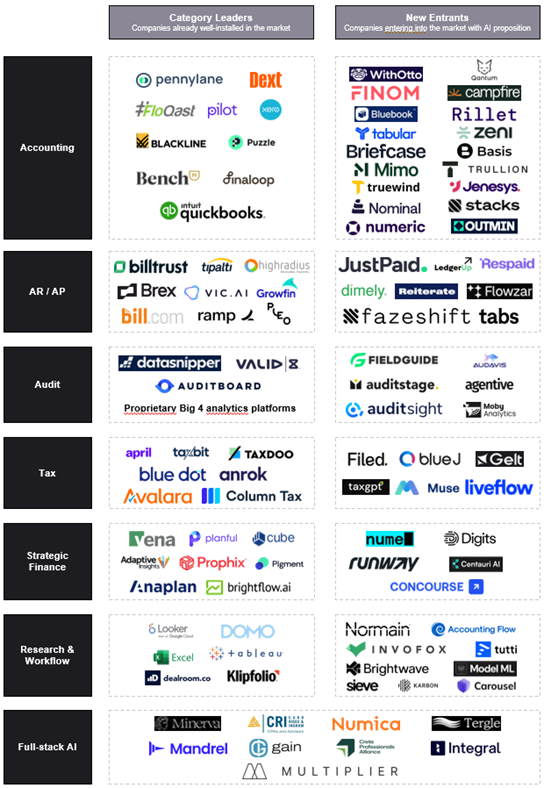
Pathways to Innovation: Product Strategies and Target Users
The product strategies driving AI adoption in accounting generally fall into two main models: AI agents and tools sold as B2B SaaS products, or full-stack AI firms operating as automated accounting practices.
Point Solutions vs. Full-Stack AI Platforms
The AI agent and tools model aligns with traditional enterprise software, where vendors build systems for specific tasks like reconciliation, invoicing, or tax filings. These SaaS solutions, which are subscription-based and continuously updated, appeal to established firms like the Big Four. They boost productivity without disrupting existing client relationships or fee structures.
Conversely, full-stack AI companies aim to become the accountants themselves. They offer end-to-end services, including bookkeeping, payroll, reporting, and tax compliance, directly to small and medium-sized enterprises (SMEs) and individuals. These firms promise faster, cheaper delivery and higher margins by compressing labor into code. Investors are backing this model, seeing a significant opportunity to disrupt incumbents entirely.
However, full-stack ventures face considerable execution risks, including licensing, liability, and operational complexities. Regardless of the model, accountants themselves must evolve into something akin to data scientists, validating AI outputs and translating insights into actionable business decisions. Successful startups in this space almost always embed accountants within their engineering teams to ensure domain expertise is integrated into scalable systems.
Empowering Accountants vs. Serving End Customers
Go-to-market models also diverge, either serving accountants directly or targeting SMBs. Companies like Pennylane or Karbon focus on accountants as primary customers and distribution partners. Their platforms facilitate collaboration with SME clients, leveraging a multiplier effect where one accountant can bring dozens of SMEs and drive higher lifetime value.
In contrast, firms like Finom adopt a direct B2B approach, targeting business owners with user-friendly, automated accounting platforms. These solutions emphasize self-service, standardized pricing, and digital marketing to reach a broader audience of entrepreneurs. The choice between these approaches significantly shapes product design, sales strategy, customer relationships, and regulatory compliance.
Key Risks and Challenges for the Future of AI in Accounting
Implementing AI in accounting comes with significant hurdles. Navigating these challenges will be crucial for successful adoption.
Reliability and Accuracy Concerns
The most immediate challenge is reliability. Generative AI systems can still be prone to hallucinations, model bias, and factual inconsistencies. These are unacceptable in a compliance-driven environment where even minor errors can have serious regulatory or legal consequences. The rise of deepfakes and synthetic data also introduces reputational risks, as malicious actors could exploit AI for fraud or misinformation in financial records.
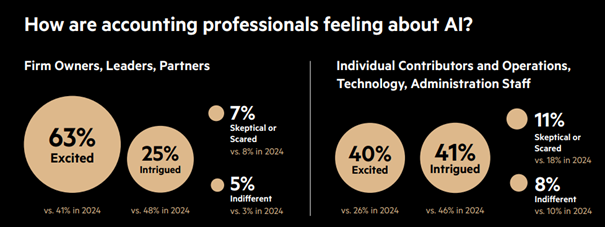
This raises a fundamental question of accountability: who is responsible when an error occurs? Regulatory frameworks typically place the burden on licensed professionals, meaning accountants remain legally and ethically accountable for their work, even when assisted by AI. This necessitates strong oversight, auditability, and robust governance mechanisms around AI adoption, which explains why some professionals remain cautious or skeptical.
Moreover, many AI initiatives in accounting struggle due to a lack of contextual understanding. Current systems often process only summary-level data without grasping the underlying transactions, attachments, and decision trails that define true accounting judgment. The next generation of AI platforms must evolve to ingest context, learning from the complete history of financial activity to deliver insights that are not only correct but also explainable.
Ultimately, in accounting, real intelligence lies in how professionals manage exceptions. Every manual correction or reclassification provides valuable information about context and intent. AI systems capable of learning from these micro-decisions can continuously refine their accuracy. Modern accounting platforms are redefining human oversight as a feedback loop, transforming each human intervention into data that strengthens future automation. This creates a self-improving ecosystem where human expertise and machine learning co-evolve, driving both precision and trust.
Business Model Design Challenges
A second risk stems from the business model mismatch. Traditional accounting relies heavily on billable hours, incentivizing partners to maximize utilization. AI dramatically reduces the time needed for routine tasks, threatening to cannibalize revenue in hourly billing departments like tax. While automation can improve margins in fixed-fee services like audit, vendors must carefully navigate these conflicting incentives. The predictable and scalable SaaS subscription model often clashes with legacy revenue structures, potentially creating resistance to AI adoption within firms.
Regulatory Hurdles and Scalability
The accounting industry operates under stringent and often fragmented regulatory regimes that vary significantly across jurisdictions. The United States benefits from a highly unified framework with a single accounting standard (US GAAP), centralized oversight, and a nationally recognized CPA credential. This coherence allows providers to scale nationally with fewer structural or regulatory barriers.
Europe, however, presents a fundamentally different landscape. Each of the 27 EU member states maintains its own local GAAP, professional licensing, audit oversight, tax codes, and payroll systems. While EU-wide initiatives exist, the practical realities of regulatory divergence remain. This results in a patchwork of obligations, making pan-European scaling significantly more complex than scaling within the United States.
For AI-driven accounting solutions, these regulatory differences translate into both technical and legal constraints. Model architectures and compliance controls often require country-specific customization, especially given Europe’s stronger emphasis on auditability, explainability, and data sovereignty. These requirements widen the scalability gap, making it more viable for AI entrants in Europe to target specific verticals or national ecosystems in the near term.
Slow Adoption Cycles
Compounding these issues are slow adoption cycles. Accounting firms are inherently risk-averse and often operate with legacy systems. This cautious approach can prolong the integration of new technologies, even those offering significant benefits.
FAQ: The Future of AI in Accounting
Q1: How will AI change the role of accountants?
AI will shift accountants’ roles from performing repetitive transactional tasks to more strategic activities. They will focus on interpreting data, analyzing anomalies, providing insights, and advising business leaders. Accountants will become data interpreters, storytellers, and risk managers.
Q2: What is “continuous closing” and how does AI enable it?
Continuous closing is a model where financial data is captured, reconciled, and validated in real time, rather than only at traditional month-ends. AI technologies like machine learning and RPA automate these processes, ensuring books are always up to date and providing instant financial insights.
Q3: What are the main risks of using AI in accounting?
Key risks include the reliability of AI systems (hallucinations, bias), ensuring accountability for errors, the lack of contextual understanding in current AI models, and the mismatch between traditional billable-hour business models and AI’s efficiency gains. Regulatory fragmentation, especially in Europe, also poses a significant challenge for scalability.
Q4: Will AI eliminate accounting jobs?
Historical parallels and expert forecasts, like those from the World Economic Forum, suggest that AI and automation will transform jobs rather than eliminate them. AI is expected to create new, high-skill roles, elevating the profession and allowing accountants to focus on higher-value strategic work.
Q5: How do AI accounting products differ in their approach?
AI accounting products generally follow two strategies: either offering AI agents and tools as B2B SaaS solutions to enhance existing accounting practices, or operating as full-stack AI firms that provide end-to-end automated accounting services directly to businesses. They also differ in whether they target accountants as primary customers or directly serve end-business owners.
Keywords: AI in accounting, accounting automation, continuous closing, financial AI, accounting technology, generative AI, machine learning finance, accounting challenges, regulatory AI, accounting innovation