Artificial intelligence (AI) is rapidly transforming industries, and accounting is no exception. With generative AI tools like ChatGPT gaining immense popularity, businesses are discovering innovative ways to boost productivity and streamline financial operations. This guide explores how an AI copilot, powered by technologies like ChatGPT, can revolutionize accounts receivable (AR) and broader accounting functions.
You’ll learn about practical applications, from automating routine tasks to gaining deeper financial insights, all while maintaining crucial human oversight. Let’s dive into how you can leverage these smart tools to enhance your financial processes.
Understanding Your AI Copilot: What is ChatGPT?
ChatGPT, developed by OpenAI, is a sophisticated generative AI model classified as a large language model (LLM). It utilizes natural language processing (NLP) to engage in human-like conversations, understand complex queries, and generate diverse outputs, including text, images, and audio.
This AI works by processing user prompts or questions, drawing from vast datasets to produce relevant and coherent responses. Software applications can also integrate ChatGPT functionalities via API, embedding its power directly into existing programs and creating an effective AI copilot for various business functions, including accounts receivable.
Current Realities and Limitations of AI Tools
While incredibly powerful, AI tools like ChatGPT are not flawless. Their effectiveness largely depends on the quality of your input and your ‘prompt engineering’ skills. Human judgment, fact-checking, and iterative refinement of prompts remain essential to ensure accuracy and relevance.
Privacy and security are also significant considerations. OpenAI advises against entering sensitive information into ChatGPT. Additionally, while models like GPT-4o continuously update, their core training data has specific cutoff dates. However, newer features like ‘Search’ and ‘Deep Research’ allow access to more current online information.
A Beginner’s Guide to AI Copilot for Accounts Receivable and Beyond
Integrating an AI copilot into your accounts receivable (AR) and general accounting processes can dramatically enhance efficiency. Here are twelve smart ways you can put AI to work for your finance team, with a special focus on how these applications apply to AR.
1. Streamlining Invoice Processing
An AI copilot can significantly aid invoice processing by automating tasks such as coding expenses. While a standalone AI might require multiple attempts for accuracy, integrated AP automation software, like Tipalti, uses embedded AI features for superior efficiency and precision.
These specialized solutions enhance account coding predictions and improve purchase order matching, directly benefiting the entire payment cycle. Though focused on payables, the underlying AI principles apply to AR, helping categorize incoming payments or identify discrepancies.
2. Automating Expense Coding
Manually coding expenses to the correct general ledger accounts can be tedious and prone to error. An AI copilot can suggest appropriate codes, learning from past transactions.
However, dedicated AP automation software with built-in AI, like Tipalti, offers far greater accuracy and efficiency for supplier invoices. For accounts receivable, this translates to faster, more accurate categorization of incoming funds.
3. Enhancing Data Cleansing
Clean data is fundamental for accurate financial reporting and successful system migrations. An AI copilot can help cleanse accounting data by identifying and removing redundant characters, standardizing names, and eliminating duplicate entries in spreadsheets or customer master files. This ensures your AR data is reliable.
4. Formatting Financial Output
If your accounting software’s default report formats don’t meet your needs, an AI copilot can reformat financial statements, tables, and reports. By inputting files and using specific prompts, you can generate customized layouts or convert data into CSV files for easy integration with other tools. This can be invaluable for presenting AR reports clearly.
5. Crafting Report Narratives and Notes
An AI copilot can generate narratives, notes, and even visualizations for financial reports. It can analyze significant fluctuations in account balances, revenues, expenses, and profitability across comparative periods, offering insights for internal reports. For AR, it can summarize trends in outstanding invoices or payment behaviors.
When preparing formal disclosures, always fact-check and supplement AI-generated content with the latest accounting standards. An AI copilot can also assist in drafting conference call scripts for investor relations, helping you prepare for questions from financial analysts.
6. Generating Computer Code
Need a custom script or an Excel macro? Your AI copilot can generate computer code in various languages, such as JavaScript, Python, R, or Excel formulas, for specific accounting tasks. If the code encounters issues, you can ask the AI to revise it, saving significant development time for custom AR reports or data manipulations.
7. Empowering Data Analysis for Decision-Making
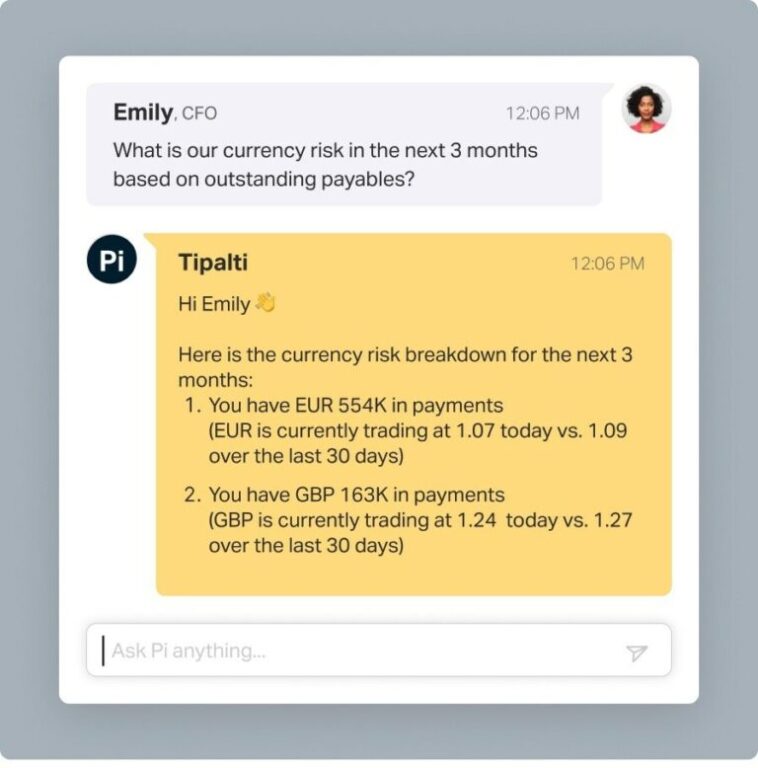
An AI copilot excels at analyzing financial data to detect anomalies, trends, or unusual percentage changes that warrant further investigation. This insightful information can drive decision-making, helping you identify opportunities for cost reductions or operational improvements. For AR, it can highlight overdue accounts needing attention or predict potential payment defaults.
Solutions like Tipalti’s Ask Tipalti AI SM, an embedded digital assistant, offer real-time financial data insights and spend analysis, showcasing the power of integrated AI.
8. Aiding Business Plan and Pitch Deck Research
Developing a comprehensive business plan or pitch deck requires extensive research. An AI copilot can perform preliminary research, helping you brainstorm ideas and generate text or images for your presentation. Always fact-check the information and provide up-to-date context, especially when dealing with financial projections. ChatGPT Pro users can access the ‘Deep Research’ functionality for more comprehensive reports.
9. Supporting Preliminary Financial Forecasts and Budgets
While not precise enough for final figures, an AI copilot can generate preliminary demand predictions, financial forecasts, and budgets. Use these as a starting point and apply your expert judgment to refine and adjust them, ensuring accuracy for your business’s specific needs. This can give your AR team a head start on cash flow predictions.
10. Assisting in Audits
During external audits, CPA firms perform analytical reviews to spot anomalies in financial data. An AI copilot can serve as an auditing aid by analyzing data for unusual patterns. As audit automation programs integrate AI, features like these will become even more common and productive, assisting both auditors and the companies preparing audit schedules.
11. Facilitating Tax and Legislation Compliance Research
Although an AI copilot isn’t ready to prepare accurate tax returns independently, it can significantly assist with tax research. You can use it to summarize new tax laws or other government legislation. By leveraging features like ‘Search’ or uploading relevant PDF documents, you ensure access to the latest compliance information.
12. Enhancing Business Communications and Brainstorming
An AI copilot is an excellent tool for brainstorming ideas and drafting various business communications, from emails to reports. You can provide prompts specifying your desired writing style, context, and tone. Always review and revise the AI-generated content for accuracy and clarity. For AR, this means drafting polite payment reminders or responses to customer inquiries quickly.
Even if you don’t use ChatGPT directly, other AI-powered tools like GrammarlyGO offer similar assistance for refining your written communications.
Beyond Basic Prompts: Streamlining Accounting Workflows
While an AI copilot can draft reports, summarize financial data, and answer ad hoc questions, its true power emerges when integrated into repeatable accounting workflows. Moving beyond simple prompts allows you to maximize finance operations with AI.
Recent Innovations in ChatGPT Features
OpenAI continuously rolls out new features that enhance ChatGPT’s capabilities:
- GPT-4 Release (March 2023): Introduced multimodal capabilities, accepting both text and image inputs. Users can now upload files directly.
- Plugin Support (March 2023): Enabled integrations with third-party services, vastly expanding functionality.
- Code Interpreter (July 2023): Offered data analysis, code execution, and file handling within the chat interface. These features are being integrated into the Responses API.
- Voice and Image Interaction (September 2023): Allowed users to interact with ChatGPT using voice and image inputs.
- DALL·E 3 Integration (October 2023): Enabled image generation directly from user prompts within ChatGPT.
- GPT-4 Turbo (November 2023): Provided a faster, more cost-effective version of GPT-4 with an expanded context window.
- GPT-4o (‘Omni’) Release (May 2024 with March 2025 update): Enhanced real-time processing of text, audio, and images, with improved instruction following and conciseness.
- o1 Model Introduction (September 2024): Focused on advanced reasoning for complex problem-solving.
- Search (October 2024): Introduced the ability for ChatGPT to search the internet for recent information, complete with source links, now available to all users.
- Operator (January 2025): Launched an AI agent capable of autonomous decision-making and task execution, like internet browsing and transactions (for Pro users, rolling out to others).
- Deep Research Tool (February 2025): Provides comprehensive research reports within minutes (initially for Pro users).
- GPT-4.5 Launch (February 2025): Introduced enhanced emotional intelligence, improved accuracy, and reduced ‘hallucinations’ for more human-like interactions (research preview for Pro users).
Frequently Asked Questions (FAQs)
Can an AI copilot fully automate accounts receivable?
While an AI copilot can significantly assist with many AR tasks, like payment matching, generating reminders, and analyzing overdue accounts, full automation still requires specialized AR software. These solutions often integrate AI tools for robust accuracy, compliance, and scalability, working in tandem with your AI copilot to optimize the process.
How can a beginner start using an AI copilot for accounts receivable?
Begin by identifying repetitive AR tasks, such as drafting follow-up emails for overdue invoices or summarizing customer payment histories. Use your AI copilot to generate initial drafts or quick analyses. Start with clear, specific prompts and gradually refine them as you become more comfortable with the tool’s capabilities. Remember to always review and verify the AI’s output.
Is an AI copilot secure for handling financial data?
When using general-purpose AI models like ChatGPT, it’s crucial to avoid inputting sensitive financial data directly due to privacy concerns. For handling proprietary financial information, opt for AI solutions embedded within secure, enterprise-grade accounting software that offers robust data protection and compliance frameworks. Always consult your company’s data security policies.
The Future of AI in Accounting and AR
AI is not just a trend; it’s the present and future of accounting and finance. Expect to see AI models, including advanced versions of ChatGPT, increasingly embedded into more software programs. This digital transformation allows businesses to future-proof their operations and scale efficiently.
Companies like Intuit are already partnering with OpenAI to integrate powerful AI into products like QuickBooks and TurboTax, signaling a future where AI assists with everything from financial statements to tax preparation. Embracing an AI copilot now will position your accounts receivable and finance teams at the forefront of this exciting evolution.
Keywords: AI copilot, accounts receivable, ChatGPT for accounting, finance automation, AI in finance, accounting software, digital transformation, financial analysis, productivity, generative AI